


Sustainability is no longer a side conversation. What once lived in policy documents and UN summits is now shaping how businesses are funded, regulated, and trusted.
According to S&P Global analysis, around 31% of revenues generated by the 1,200 largest global companies come from activities aligned with the EU Taxonomy for Sustainable Activities, illustrating how deeply sustainability is embedded in modern business models.
According to a recent EcoVadis survey, the Sustainable Development Goals (SDGs) are increasingly shaping business decisions, with 87% of US executives in 2025 maintaining or increasing their sustainability investments and viewing these efforts as a competitive advantage.
For businesses seeking to remain relevant in a rapidly evolving world, understanding the SDGs is becoming less about responsibility and more about a key strategic approach.
Table of Contents
Why the SDGs Matter Today and in 2025
The relevance of the Sustainable Development Goals has increased sharply over the last few years.
The challenges they address are no longer distant or theoretical. Climate change is disrupting supply chains. Social inequality is affecting workforce stability. Resource scarcity is reshaping cost structures and long-term planning.
For businesses, these are not ethical debates. They are operational realities.
Regulation is tightening across multiple regions, particularly around emissions, labor practices, environmental impact, and supply chain transparency.
Investors are increasingly factoring sustainability risks into decision-making, with global sustainable investment assets crossing US$30.3 trillion, a figure widely referenced by institutions tracking sustainable finance trends.
Supply chains are under growing scrutiny. Large companies are asking suppliers to disclose environmental and social data, often mapped directly to SDG themes.
Customers are paying attention as well. Trust, credibility, and brand perception are now closely tied to how businesses respond to global challenges.
In this context, the SDGs matter because they provide a shared framework. They help businesses understand expectations, communicate intent, and position themselves as resilient and future-ready rather than reactive.
What Are the Sustainable Development Goals
The Sustainable Development Goals (adopted in 2015 and targets to be achieved by 2030) consist of 17 interconnected goals designed to address the world’s most pressing social, environmental, and economic challenges.
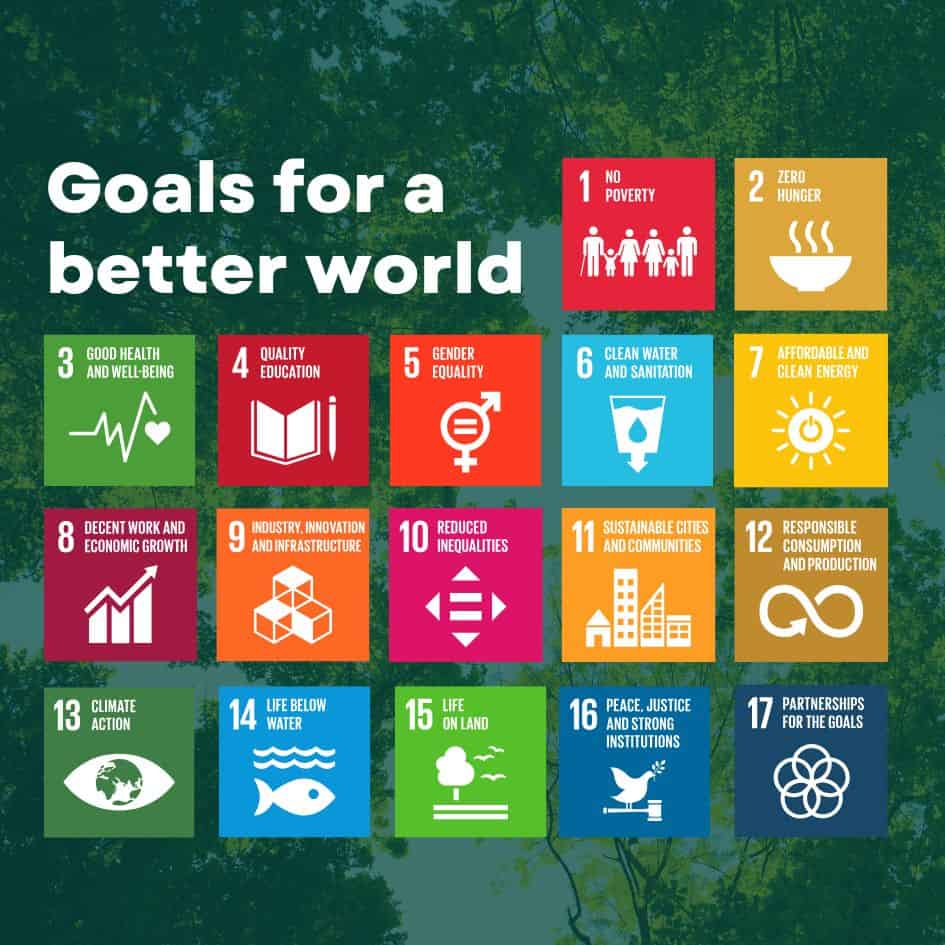
Each goal focuses on a specific outcome, but none of them function in isolation. Together, they form a framework for long-term, inclusive, and resilient development.
SDG 1: No Poverty
This goal aims to eliminate extreme poverty in all its forms. It focuses on access to basic needs, economic resources, and social protection systems that help people withstand financial shocks.
SDG 2: Zero Hunger
The objective is to end hunger and promote sustainable agriculture. It addresses food security, nutrition, and farming practices that can support growing populations without degrading land and ecosystems.
SDG 3: Good Health and Well Being
This goal focuses on ensuring healthy lives for people of all ages. It includes access to healthcare, disease prevention, mental health, and reducing mortality from preventable causes.
SDG 4: Quality Education
The aim is to ensure inclusive and equitable education and lifelong learning opportunities. Education is treated as a foundation for economic mobility, innovation, and social stability.
SDG 5: Gender Equality
This goal seeks to eliminate discrimination and inequality faced by women and girls. It covers equal access to education, employment, leadership, and protection from violence.
SDG 6: Clean Water and Sanitation
The focus here is on ensuring access to safe water and sanitation for all. It also emphasizes sustainable water management and reducing pollution of freshwater resources.
SDG 7: Affordable and Clean Energy
This goal promotes access to reliable, affordable, and sustainable energy. It supports the transition toward renewable energy sources and improved energy efficiency.
SDG 8: Decent Work and Economic Growth
The objective is to promote inclusive economic growth and productive employment. It addresses labor rights, safe working conditions, and opportunities for meaningful work.
SDG 9: Industry, Innovation and Infrastructure
This goal focuses on building resilient infrastructure and fostering innovation. It supports sustainable industrialization and the adoption of new technologies.
SDG 10: Reduced Inequalities
The aim is to reduce income and opportunity inequalities within and between countries. It includes social, economic, and political inclusion of marginalized groups.
SDG 11: Sustainable Cities and Communities
This goal addresses urban development challenges. It focuses on housing, transportation, waste management, and making cities safe, inclusive, and resilient.
SDG 12: Responsible Consumption and Production
The objective is to reduce waste and resource use by promoting sustainable production and consumption patterns. It encourages efficiency across supply chains.
SDG 13: Climate Action
This goal focuses on addressing climate change and its impacts. It includes mitigation, adaptation, and building resilience to climate-related risks.
SDG 14: Life Below Water
The aim is to protect oceans and marine ecosystems. It addresses issues such as pollution, overfishing, and the sustainable use of marine resources.
SDG 15: Life on Land
This goal focuses on protecting terrestrial ecosystems. It includes biodiversity conservation, forest management, and combating land degradation.
SDG 16: Peace, Justice and Strong Institutions
The objective is to promote peaceful societies and accountable institutions. It covers access to justice, transparency, and effective governance.
SDG 17: Partnerships for the Goals
This final goal emphasizes collaboration. It highlights the importance of partnerships between governments, businesses, civil society, and institutions to achieve the SDGs.
Together, these 17 goals provide a shared reference point for understanding global challenges and the outcomes needed to build a sustainable future.
SDGs and Business Responsibility
The Sustainable Development Goals are often discussed at a global level, but their impact is felt most clearly through business activity.
Companies influence the SDGs in two primary ways. The first is direct impact, which comes from day-to-day operations such as energy use, employment practices, sourcing decisions, and waste generation. The second is indirect impact, which flows through supply chains, distribution networks, product use, and end-of-life outcomes.
Many businesses underestimate their indirect influence. A company may not extract raw materials or manufacture products, yet its procurement and design choices can shape environmental and social outcomes across multiple geographies.
This is why responsibility cannot be limited to internal operations alone. Value chains often account for a much larger share of environmental and social impact than direct activities.
From a business perspective, SDGs represent both risk and opportunity.
Poor alignment can expose companies to regulatory penalties, supply disruptions, and reputational damage.
Strong alignment, on the other hand, can improve resilience, attract investment, and strengthen long-term competitiveness.
In practice, business responsibility under the SDGs is less about philanthropy and more about how core decisions are made, measured, and improved over time.
How Can CSR Activities Contribute to the Sustainable Development Goals
Corporate Social Responsibility is often viewed as a compliance requirement or a fixed annual spend. In practice, CSR has far greater potential when it is designed with intent and alignment.
At its core, CSR is meant to address social and environmental challenges linked to a company’s presence and influence. When CSR initiatives are aligned with the SDGs, they move beyond isolated activities and contribute to clearly defined global outcomes.
Well-designed CSR programs can support goals related to education, healthcare, clean energy, livelihoods, environmental protection, and community resilience. The impact depends less on how much is spent and more on how closely the initiative connects to a specific SDG and a measurable outcome.
The difference between random CSR spending and SDG-aligned CSR lies in focus.
Random initiatives may generate short-term visibility but rarely create lasting impact.
SDG-aligned CSR prioritizes relevance, continuity, and outcomes that can be tracked over time.
Outcome-based CSR also enables better accountability. Instead of reporting activities completed, businesses can report progress made toward specific social or environmental objectives.
This shift strengthens credibility and ensures CSR efforts contribute meaningfully to sustainable development rather than functioning as standalone obligations.
How Businesses Can Align With the SDGs
Alignment with the Sustainable Development Goals works best when it is selective and intentional. Addressing all 17 goals often leads to vague commitments and weak execution.
The first step is prioritisation. Businesses should identify a small number of SDGs that are directly linked to their strategic objectives and risk exposure, rather than treating the goals as a checklist.
The next step is integration. SDGs should be reflected in business planning, internal policies, and decision-making processes. This ensures alignment influences how the business operates, not just how it communicates.
Measurement is critical. Without clear indicators, alignment remains symbolic. Businesses need to track progress in ways that are relevant to their chosen SDGs and transparent to stakeholders.
When alignment is treated as a strategic process rather than a branding exercise, SDGs become a tool for focus, accountability, and long-term value creation.
SDGs vs ESG vs CSR vs Sustainability
These terms are often used interchangeably, but they serve different purposes and operate at different levels.
The Sustainable Development Goals define global priorities. They describe the outcomes the world is trying to achieve across social, environmental, and economic dimensions. SDGs provide direction, not measurement.
ESG focuses on assessment and disclosure. It translates environmental, social, and governance factors into data points that investors and regulators use to evaluate risk, performance, and long-term viability. ESG frameworks help compare companies, but they do not define societal goals.
CSR is action-oriented. It represents how businesses implement social and environmental initiatives, often through programs, partnerships, or investments. CSR can contribute to SDGs when initiatives are aligned, but on its own, it does not guarantee impact.
Sustainability is the overarching strategy. It is about building a business model that can operate profitably over time without creating environmental, social, or economic risks that undermine future growth.
Understanding the distinction matters. SDGs set the destination, ESG measures the journey, CSR delivers specific actions, and sustainability connects them into a coherent long-term business approach.
Common Misunderstandings About the SDGs
One common misunderstanding is that the SDGs are only relevant to governments or large multinational corporations.
In reality, businesses of all sizes influence social and environmental outcomes through their operations and supply chains.
Another misconception is that the SDGs focus only on environmental issues. While climate and resource use are important, many goals address social and economic challenges such as health, education, employment, and inequality.
There is also a tendency to equate CSR activity with SDG alignment. A single initiative or short-term program does not automatically translate into a meaningful contribution. Alignment requires consistency, relevance, and measurable outcomes over time.
This gap between intent and impact is visible in reporting practices as well. A global survey by KPMG found that while around 74% of the world’s largest companies reference the SDGs in their reporting, only 10% report comprehensively across the full 2030 Agenda, and just 6% assess their actual positive or negative impact on the goals.
Some businesses assume that selecting one SDG is sufficient. In practice, activities often influence multiple goals, both positively and negatively. Ignoring these interconnections can lead to incomplete or misleading claims.
Clarifying these misunderstandings is essential. Without clarity, SDGs risk being treated as symbolic commitments rather than practical frameworks for responsible and resilient business decisions.
How SDGs Fit Into the Future of Sustainable Business
The role of the Sustainable Development Goals is evolving from guidance to expectation.
Policy direction across major economies is increasingly aligned with outcomes reflected in the SDGs, particularly around climate action, labour standards, transparency, and resource efficiency. As regulations tighten, businesses that already operate in alignment with these outcomes are better positioned to adapt without disruption.
Capital markets are moving in the same direction. Investors are looking beyond short term performance and assessing how businesses manage long term environmental and social risks. SDG-aligned strategies help signal resilience, credibility, and preparedness in a changing economic landscape.
Innovation is also being shaped by SDG priorities. Many emerging business models, from clean energy and circular economy solutions to inclusive finance and sustainable agriculture, are directly addressing challenges defined by the goals. This alignment is opening new markets rather than restricting growth.
The business opportunity is significant. The Business & Sustainable Development Commission has estimated that achieving the SDGs could unlock at least 12 trillion dollars in new market opportunities across sectors such as food systems, cities, energy, and health. This highlights how SDG alignment is increasingly linked to growth, innovation, and competitive advantage.
In this context, the SDGs function less as a checklist and more as a decision-making lens. They help businesses evaluate trade-offs, anticipate future pressures, and identify opportunities that align commercial success with long term societal value.
As sustainable business continues to mature, companies that treat the SDGs as part of strategic thinking, rather than external obligations, are more likely to remain competitive, credible, and relevant in the years ahead.