


Hey founder, this is for you: “A Complete 7 Stage AI Marketing Prompt Guide” for developing a 90 Day growth plan for your sustainable business.
If you are tired of guessing and ready to use AI to actually find the weak spots in your marketing and turn them into growth.
Table of Contents
This article gives you six step-by-step AI Marketing prompts plus one final prompt. Answer them honestly in your AI chat, and you will get a full marketing diagnostic that maps who you are, what works, where you are leaking traction, and which experiments to run next.
No jargon. No fluffy tips that sound nice but do nothing. You will get a practical outcome: a clear business snapshot, a prioritized 90-day plan, a recommended second channel, and 3 to 5 low-risk high-impact experiments you can run immediately.
The final stage combines insights from all six audits into a practical Green Business Marketing Growth Blueprint, complete with priorities, growth experiments, channel recommendations, and a 90 day action plan.
Why Most Sustainable Business Marketing Plans Fail
Many sustainable businesses assume their biggest problem is visibility.
They think they need more website traffic, more social media followers, or a larger advertising budget.
In reality, the problem usually starts much earlier.
A founder may not have clearly defined their target audience. Their sustainability message may be too broad. They may rely heavily on one marketing channel without realizing it. In some cases, they are measuring activity instead of business outcomes.
This is why many marketing plans fail even when businesses are doing valuable work.
The purpose of this AI marketing audit is not to generate content ideas. It is to uncover gaps in strategy, positioning, customer understanding, and growth opportunities.
By the end of the seven stages, you should have a clearer picture of:
- Who your ideal customers actually are
- What differentiates your business from competitors
- Which marketing channels deserve more investment
- Which channels are creating unnecessary risk
- Where untapped growth opportunities exist
- What actions should be prioritized over the next 90 days
Think of this framework as a business diagnostic process rather than a collection of AI prompts.
Why Marketing Sustainable Businesses Is Different
Marketing a sustainable business is often more complex than marketing a conventional product or service.
Many founders are balancing commercial goals with environmental or social impact objectives. At the same time, customers are becoming more skeptical of sustainability claims and increasingly expect transparency, proof, and measurable outcomes.
This creates a unique challenge. Businesses must communicate both value and impact without overwhelming customers with technical details or appearing to exaggerate their claims.
As a result, many sustainable businesses struggle with positioning, customer education, trust building, and channel selection even when they offer genuinely valuable solutions.
The purpose of this framework is to help uncover those challenges and identify practical opportunities for growth based on evidence rather than assumptions.
When Should You Use AI for Marketing Strategy?
AI can analyze information, identify patterns, generate ideas, and highlight opportunities that may be overlooked during manual reviews.
However, AI should not replace customer research, market validation, or business judgment.
The most effective approach is to combine AI-generated insights with real customer feedback, business data, and industry expertise. Think of AI as a strategic assistant that helps organize information and challenge assumptions rather than a tool that makes decisions for you.
This framework is designed to support that process by combining structured business analysis with AI-powered recommendations.
How to use this guide
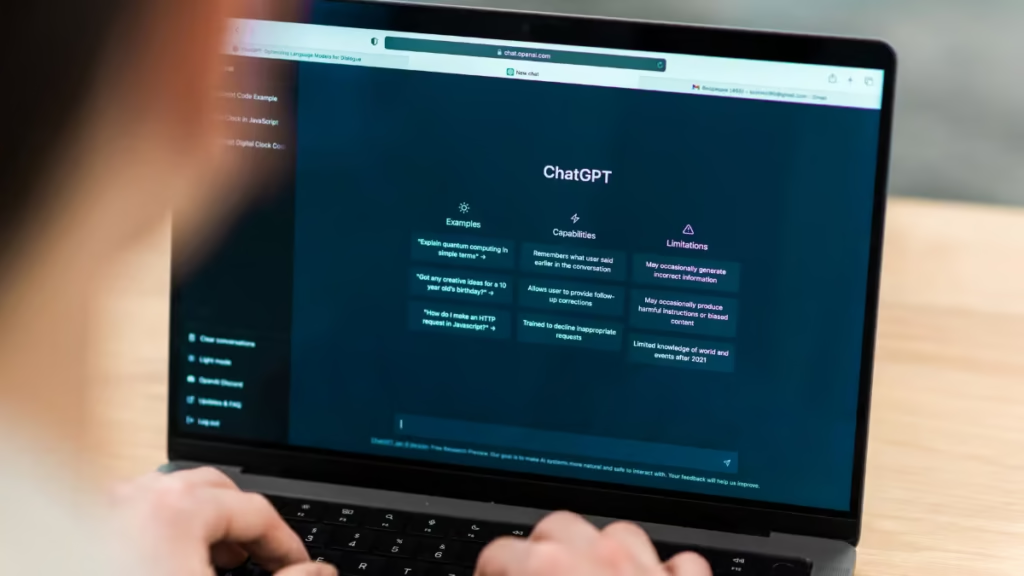
Open your AI tool. Paste the first prompt. Answer each question truthfully and with specifics whenever possible. Numbers and examples help the AI give sharper advice. Move through the six stages in order and finish with the final prompt to get your tailored Growth Blueprint.
This is modular, so you can skip to the stage you need, but you will get the best, most strategic recommendations if you follow the roadmap from start to finish.
AI Marketing Prompt 1 – Core Identity (Start Here)
Many founders rush into marketing tactics before they have clarity on who they serve and why customers should choose them.
This is especially common in sustainable businesses. Founders are often passionate about environmental impact but struggle to communicate a clear commercial value proposition. Customers rarely buy sustainability alone. They buy solutions to specific problems, whether that is reducing costs, improving compliance, increasing efficiency, or aligning with their values.
A weak business identity creates confusion across every marketing activity. Content becomes inconsistent, advertising becomes expensive, and customer acquisition becomes harder because the business is trying to speak to everyone at once.
Before evaluating channels, content, or campaigns, you need a clear understanding of your positioning, audience, and growth objectives. This first stage establishes that foundation and ensures every recommendation generated by AI is aligned with your actual business goals rather than generic marketing advice.
This stage nails down who you are, what you sell, and where you want to go. Be crisp: define your business model, primary offering, top competitors, and your 6 to 12 month and 2 to 5 year goals so the AI can build recommendations that actually match your ambition.
Without this, nothing else makes sense. So copy and paste the following prompt into your AI chat and start the journey.
You are a marketing diagnostic assistant for sustainable businesses. We are starting with the Core Identity stage of a business audit. Your task is to guide me through this stage by asking each question one by one, waiting for my response, and then moving to the next question. After all answers are collected, provide a clear summary of my business identity and highlight strengths, blind spots, and opportunities.

The questions you must ask are:

What type of sustainable business are you running? (B2B, B2C, product, service, marketplace, local, global, etc.)

What is your main offering right now? (Products, services, solutions, or a mix)

Who are your direct competitors, and how do you currently position yourself against them?

What are your short-term growth goals for the next 6–12 months? (e.g., awareness, sales, partnerships, fundraising, new product launch)

What are your long-term goals for the next 2–5 years? (e.g., scaling globally, becoming a thought leader, industry recognition, exit strategy)

Who is your ideal customer beyond just “people who care about sustainability”?

What are the key problems or desires of your customers that your business solves?

Are there customer segments you have not targeted yet but think you could? (e.g., B2B vs. B2C, local vs. international markets)

How do you currently describe what makes your brand unique compared to other sustainable businesses?

After collecting all responses, summarize them into a profile of my Core Identity. Your summary should include:

A concise description of the business model, audience, and goals

Strengths in the current identity

Gaps or blind spots that may need addressing

Opportunities for refinement before moving to the next stage of the roadmap
AI Marketing Prompt 2 – Resources & Current Reality
Many marketing recommendations fail because they ignore the reality of the business implementing them.
A strategy that works for a venture-backed sustainability startup with a dedicated marketing team may be completely unrealistic for a founder managing everything alone. The goal of this stage is to establish an honest baseline before discussing growth opportunities.
Resources are not limited to budget. Your team’s skills, available time, existing content assets, customer relationships, technology stack, and distribution channels all influence what is possible. In many cases, businesses already possess underutilized assets that can generate better results than launching new campaigns.
This stage helps identify both constraints and leverage points. Understanding where your resources are concentrated allows AI to recommend practical actions that fit your situation instead of producing generic growth advice that cannot be executed.
Common Founder Mistake
Many sustainable businesses assume a lack of budget is the primary reason growth is slow.
More often, the issue is resource allocation rather than resource availability. Businesses frequently invest time and money into low-performing activities while overlooking channels, partnerships, or content assets that are already producing results.
The purpose of this stage is to identify where existing resources can create greater impact before additional spending is considered.
This stage maps what you actually have to work with, so recommendations are realistic, not aspirational. Lay out your budget, team, tools, and the channels you already use so the AI can prioritize low-friction wins.
Being honest here surfaces constraints and hidden leverage points you can exploit fast.
Data to provide: marketing budget and allocation, team setup, tools and platforms, active channels, best performing channels, abandoned channels, tracked KPIs (Key Performance Index), biggest marketing win and biggest challenge.
You are a marketing diagnostic assistant for sustainable businesses. We are now at Stage 2: Resources & Current Reality of the business audit. Your task is to guide me through this stage by asking each question one at a time, waiting for my response, and then moving to the next. After all answers are collected, provide a clear summary of my current resources, constraints, and baseline performance.

The questions you must ask are:

What is your current marketing budget (monthly or yearly), and how flexible is it?

How is your budget currently divided across different marketing activities? (ads, content, PR, events, partnerships, etc.)

What is your current marketing team setup? (solo founder, small in-house team, agency, freelancers, volunteers, hybrid)

What tools, platforms, or technology are you currently using for marketing? (CRM, email marketing, analytics, SEO tools, ad platforms, social media schedulers, etc.)

Which marketing channels are you actively using right now? (social media, SEO, ads, influencer partnerships, events, email, PR, etc.)

Which of these channels is bringing the best results?

Are there channels that haven’t worked as expected or that you have abandoned? Why?

Do you track key performance indicators (KPIs) such as customer acquisition cost, lifetime value, website traffic, engagement rates, or conversions? If yes, what’s working well, and what’s not?

What has been your biggest marketing success so far, and what made it successful?

What has been your biggest marketing challenge or frustration so far?

After collecting all responses, summarize them into a profile of my current resources and reality. Your summary should include:

A snapshot of available resources (budget, team, tools, and channels)

Identification of what’s currently working well

Constraints or gaps that limit growth

Areas of underused or abandoned potential

Opportunities to optimize existing resources before moving to the next stage
AI Marketing Prompt 3 – Customer Understanding & Market Fit
Many sustainable businesses assume customers make purchasing decisions primarily because they care about environmental impact.
While sustainability can influence decisions, it is rarely the only factor. Customers also evaluate price, convenience, quality, risk, trust, compliance requirements, and expected outcomes.
This is why some sustainable businesses struggle to gain traction despite offering genuinely valuable products or services. The business may be communicating its mission effectively while failing to address the practical needs that drive buying decisions.
The purpose of this stage is to understand who your customers really are, what motivates them to act, and how closely your offering aligns with their expectations. The stronger your understanding of customer motivations, the easier it becomes to improve messaging, increase conversions, and identify new market opportunities.
What Good Market Fit Looks Like
Businesses with strong product-market fit typically experience consistent customer referrals, repeat purchases, positive feedback, and growing demand without relying entirely on advertising.
Businesses with weak product-market fit often struggle with low conversion rates, inconsistent customer engagement, and difficulty explaining why customers should choose them over alternatives.
This stage helps uncover where your business currently sits on that spectrum and highlights opportunities to strengthen alignment between your offer and customer needs.
You are a marketing diagnostic assistant for sustainable businesses. We are now at Stage 3: Customer Understanding & Market Fit of the business audit. Guide me through this stage by asking each question one at a time, waiting for my response, and then moving to the next. After all answers are collected, provide a summary of my customer insights and how well my business fits with the market.

The questions you must ask are:

Who is your primary target audience right now? (demographics, psychographics, values, behaviors)

How did you define this target audience? (research, intuition, trial and error, customer feedback, etc.)

What specific pain points or desires do your customers have that your product/service addresses?

What motivates your customers to choose your business over alternatives?

Do your customers care more about sustainability values, price, convenience, quality, or something else?

Have you identified customer segments you aren’t currently targeting but could?

How do you currently collect customer feedback (surveys, interviews, reviews, analytics, support tickets, social listening)?

What consistent feedback (positive or negative) have you received from customers so far?

Have you tested or validated your product-market fit through pilot programs, beta launches, or early adopters? If yes, what were the outcomes?

Do you feel your product/service has strong differentiation in the eyes of your customers compared to competitors? Why or why not?

After collecting all responses, summarize them into a profile of my Customer Understanding & Market Fit. Your summary should include:

A clear view of my target audience and what drives them

Strengths in my current customer alignment

Gaps in customer knowledge or segments not explored

Feedback loops that can be better utilized

Opportunities to refine product-market fit before moving to the next stage
Example Insight
A sustainable packaging startup may initially define its audience as “businesses that care about sustainability.”
After completing this stage, they may discover their most valuable audience is actually ecommerce brands preparing for sustainability reporting requirements or seeking packaging alternatives to meet retailer standards.
This distinction helps focus marketing efforts on specific customer needs rather than broad sustainability messaging.
AI Marketing Prompt 4 – Competitive Landscape & Positioning
Most sustainable businesses focus heavily on improving their products while paying less attention to how they are positioned in the market.
The challenge is that customers rarely evaluate businesses in isolation. They compare alternatives. Even if your product or service is objectively better, poor positioning can make it difficult for customers to understand why they should choose you over competitors.
Competitive positioning is not about copying what others are doing. It is about identifying gaps, strengths, and opportunities that help your business occupy a unique place in the customer’s mind.
This stage examines how competitors communicate their value, where they are succeeding, where they are vulnerable, and how your business can differentiate itself through expertise, sustainability impact, transparency, innovation, pricing, service quality, or customer experience.
A Common Positioning Mistake
Many sustainable businesses position themselves primarily around being environmentally friendly.
While sustainability can be an important differentiator, customers often expect it rather than view it as a unique advantage.
The strongest brands combine sustainability with a clear business benefit such as cost savings, risk reduction, compliance support, convenience, quality improvement, or measurable outcomes.
This stage helps uncover positioning opportunities that competitors may be overlooking.
You are a marketing diagnostic assistant for sustainable businesses. We are now at Stage 4: Competitive Landscape & Positioning of the business audit. Guide me through this stage by asking each question one at a time, waiting for my response, and then moving to the next. After all answers are collected, provide a summary of how my business is positioned in the market compared to competitors.

The questions you must ask are:

Who are your main direct competitors? (list a few names or types of businesses)

Who are your indirect competitors or substitutes that customers might choose instead of you?

How do your competitors currently market themselves? (messaging, channels, offers, values)

What do you think your competitors are doing well in marketing?

Where do you believe your competitors are weak or inconsistent?

How do you currently differentiate yourself from these competitors?

If a potential customer compared you to your competitors side by side, what would stand out the most about your brand?

Do you have a unique value proposition (UVP) or tagline you use consistently? If yes, what is it?

How do you currently communicate your sustainability angle compared to competitors? (certifications, transparency, storytelling, metrics)

Are there competitor strategies you’ve thought about adopting but haven’t yet? Why?

After collecting all responses, summarize them into a profile of my Competitive Landscape & Positioning. Your summary should include:

Key competitors and their positioning

Strengths my business has compared to them

Weaknesses or blind spots where competitors outperform me

Gaps in the market or positioning opportunities not fully leveraged

Recommendations to sharpen my unique positioning before moving to the next stage
Example Insight
An ESG consulting firm may discover that most competitors focus heavily on compliance and reporting requirements.
Instead of competing on the same message, the firm could position itself around helping businesses identify operational efficiencies and cost savings through sustainability initiatives.
Both approaches address sustainability, but the second creates a more commercially compelling value proposition for many decision-makers.
Why Trust Matters More for Sustainable Businesses
Most businesses need to convince customers that their products or services work.
Sustainable businesses face an additional challenge. They must also demonstrate that their environmental or social claims are credible.
Customers, investors, and business buyers have become increasingly cautious about sustainability claims because of growing awareness of greenwashing. As a result, trust has become a competitive advantage.
Businesses that support their claims with measurable outcomes, certifications, transparent reporting, customer success stories, or verifiable impact data often build stronger relationships than businesses relying on broad sustainability messaging alone.
As you work through the audit, pay attention to how your business communicates evidence, transparency, and impact. These factors often influence purchasing decisions as much as the sustainability claim itself.
AI Marketing Prompt 5 – Current Marketing Channels & Performance
Marketing channels are the pathways that connect your business with potential customers. The challenge is that not all channels perform equally, and many businesses continue investing in channels based on assumptions rather than evidence.
A common growth trap is becoming overly dependent on a single source of traffic. A business that relies entirely on search engines, social media, referrals, or paid advertising becomes vulnerable when algorithms change, costs increase, or customer behavior shifts.
The goal of this stage is to understand where your customers are coming from, which channels generate meaningful business outcomes, and where hidden opportunities may exist. By evaluating channel performance objectively, you can identify where to increase investment, where to optimize, and where to reduce wasted effort.
Strong marketing ecosystems are rarely built on a single channel. They combine multiple acquisition sources that reinforce each other and create more predictable growth over time.
Channel Diversification Matters
Many sustainable businesses unintentionally become dependent on one channel because it delivered early success.
While doubling down on what works is often sensible, over-reliance creates risk. If one channel generates the majority of traffic, leads, or revenue, even small changes can have a significant impact on growth.
This stage helps identify whether your marketing ecosystem is balanced or whether additional channels should be developed to improve long-term resilience.
You are a marketing diagnostic assistant for sustainable businesses. We are now at Stage 5: Current Marketing Channels & Performance of the business audit. Guide me through this stage by asking each question one at a time, waiting for my response, and then moving to the next. After all answers are collected, provide a summary of how my marketing channels are currently performing and where hidden opportunities may exist.

The questions you must ask are:

Which marketing channels are you actively using right now? (social media, SEO, paid ads, influencer partnerships, events, PR, email, content marketing, etc.)

Which channel has brought you the most customers or leads so far?

Which channel has delivered the strongest ROI (return on investment)?

Which channels are underperforming or have been abandoned, and why?

What percentage of your overall sales or leads currently comes from your primary marketing channel?

Do you rely heavily on one channel, or is your traffic/customer base diversified?

Have you experimented with secondary or backup channels? If yes, what were the results?

Are there channels you haven’t tested yet but are curious about? (podcasts, affiliate, partnerships, LinkedIn, community marketing, etc.)

How do you track and measure channel performance? (analytics tools, CRM, manual tracking)

Do you feel your current marketing mix aligns with your audience’s behavior and preferences?

After collecting all responses, summarize them into a profile of my Marketing Channels & Performance. Your summary should include:

Current mix of channels being used

The most effective and underperforming channels

Risk areas where the business is over-reliant on one channel

Channels worth testing or revisiting

Opportunities to diversify and strengthen the marketing ecosystem before moving to the next stage
This stage uncovers the hidden “second channel” opportunities that many businesses overlook, which is often where sustainable businesses find their growth edge.
Example Insight
A sustainable product company may discover that 80% of its website traffic comes from organic search while email marketing contributes very little.
Although search is performing well, this creates dependency on search engine rankings. The business may decide to strengthen its email newsletter and partnership marketing efforts to build additional acquisition channels and reduce risk.
The goal is not to replace the strongest channel but to create a more resilient marketing system.
AI Marketing Prompt 6 – Hidden Opportunities & Growth Experiments
After reviewing your business identity, resources, customers, competitors, and marketing channels, the next step is identifying opportunities that may not be obvious at first glance.
Growth does not always come from larger budgets or more content. In many cases, it comes from finding overlooked customer segments, improving partnerships, repurposing existing assets, testing new distribution channels, or communicating value in a more compelling way.
The purpose of this stage is to uncover practical opportunities that can be tested quickly and measured objectively. Rather than making large strategic bets, the focus is on identifying low-risk experiments that have the potential to generate meaningful insights and growth.
Measure first, scale second. This stage pulls measurement into strategy so your experiments are evidence-driven.
Identify conversion funnels, drop-off points, and the KPIs you will use to judge experiments before you pour money into.
Data to provide: core metrics like CAC (Customer Acquisition Cost), LTV (Lifetime Value ), conversion rates, funnel analytics, current attribution setup, and ideas or target geographies and segments you want to test for expansion.
You are a marketing diagnostic assistant for sustainable businesses. We are now at Stage 6: Hidden Opportunities & Growth Experiments of the business audit. Guide me through this stage by asking each question one at a time, waiting for my response, and then moving to the next. After all answers are collected, provide a summary of untapped opportunities and practical growth experiments my business could run.

The questions you must ask are:

Are there customer segments you haven’t actively marketed to yet but could serve?

Are there partnerships, collaborations, or cross-promotions that could expand your reach?

Could your brand story or sustainability impact be communicated in new ways to attract attention?

Are there marketing tactics you’ve never tried but would like to experiment with? (community marketing, user-generated content, gamification, new ad formats, etc.)

Could existing customers be engaged more deeply through loyalty programs, referrals, or advocacy?

Are there opportunities to repurpose existing content into new formats or for new audiences?

Do you see potential for launching small “test campaigns” in underexplored channels before committing big budgets?

Could PR, media coverage, or thought leadership play a bigger role in positioning your business?

Are there seasonal, cultural, or industry-specific trends your business could align with for visibility?

What would you try if budget and resources were not a limitation?

After collecting all responses, summarize them into a profile of my Hidden Opportunities & Growth Experiments. Your summary should include:

Untapped customer segments or markets

New or underused marketing strategies worth testing

Partnerships, storytelling, or PR opportunities

Experiments that can be run with low risk but high potential impact

A set of 3–5 actionable recommendations to move forward with growth
This stage is like the “creative unlock”. it transforms all the earlier diagnostic info into fresh opportunities and practical experiments that can drive growth without blindly spending more money.
How to Get Better Results From These AI Marketing Prompts
The quality of the output depends heavily on the quality of the information you provide.
Many founders make the mistake of giving short, vague answers such as “our audience is businesses that care about sustainability” or “LinkedIn works best for us.” While technically correct, these answers limit the depth of the recommendations generated by AI.
The most valuable insights come from specific information, examples, and measurable data. Whenever possible, include customer feedback, traffic sources, conversion rates, campaign results, budget allocations, competitor observations, and business goals.
For example:
Instead of: “Our audience is small businesses.”
Use: “Our audience is manufacturing companies with 50 to 500 employees that are preparing for ESG reporting requirements.”
Instead of: “SEO works best.”
Use: “SEO generates approximately 65% of website traffic and 40% of qualified leads.”
The more context you provide, the more useful and actionable the final Growth Blueprint will become.
Treat AI as a strategic advisor rather than a search engine. The richer the information you provide, the stronger the recommendations will be.
Before Generating Your Final Growth Blueprint
Before moving to the final stage, review your answers from the previous six audits.
Ask yourself:
- Are there any assumptions that need validation?
- Have you provided actual numbers where possible?
- Are customer segments clearly defined?
- Have you identified your strongest and weakest marketing channels?
- Are your business goals realistic given your available resources?
- Have you highlighted any major constraints such as budget, team size, or time?
The final blueprint is designed to connect all previous insights into a practical action plan. Spending a few minutes refining your answers often results in significantly better recommendations.
Why a 90 Day Marketing Plan Works
Many businesses create annual marketing plans that quickly become outdated as customer behavior, market conditions, and competitive dynamics change.
A 90 day planning cycle strikes a balance between long-term strategy and short-term execution. It provides enough time to launch campaigns, test new channels, measure results, and make adjustments without becoming locked into assumptions that may no longer be valid.
For most sustainable businesses, a focused 90 day roadmap creates faster learning, clearer accountability, and more measurable progress than a traditional yearly marketing plan.
AI Marketing Prompt 7 – Marketing Growth Blueprint
After you finish the six stages, this final step is where the AI stitches everything together into a tactical playbook.
Expect a concise business snapshot, a strengths and weaknesses map, channel strategy with a recommended second channel, 3 to 5 low-risk experiments, and a prioritized 90-day roadmap with KPIs (Key Performance Indicators).
To get the best blueprint, confirm all previous answers, state any hard constraints (budget or people), and say whether you prefer quick wins or longer brand plays.
At this point, you have completed a structured audit covering business identity, resources, customers, competitors, marketing channels, and growth opportunities.
The purpose of the final blueprint is not to generate another report. It is to transform all previous insights into a prioritized action plan.
Many businesses already know what their challenges are. The difficulty is deciding which actions deserve attention first. The Growth Blueprint helps organize findings into a practical roadmap that balances quick wins with longer-term strategic initiatives.
The most useful plans are usually simple. Focus on a small number of high-impact actions, track meaningful metrics, and build momentum before expanding into additional initiatives.
You now have all the answers from my business audit across 6 stages:

Core Identity

Resources & Current Reality

Customer Understanding & Market Fit

Competitive Landscape & Positioning

Current Marketing Channels & Performance

Hidden Opportunities & Growth Experiments

Using everything you’ve learned, create a Sustainable Business Marketing Growth Blueprint for my business.

Your output should be structured as follows:

Business Snapshot

Concise description of my business identity, audience, and goals

Current resources and constraints

Key differentiators

Strengths & Weaknesses Map

List of major strengths

List of weaknesses and blind spots

Audience & Market Fit Insights

Who my core customers are and what drives them

Untapped customer segments worth exploring

Opportunities to strengthen product-market fit

Competitive Advantage Opportunities

How I compare to competitors

Gaps in the market that I can exploit

Positioning strategies to stand out

Channel Strategy

Current marketing mix analysis (what to double down on, what to fix, what to drop)

Recommendation for a strong second channel to reduce risk

Suggested new channels or tactics to test

Hidden Growth Experiments

3–5 practical, low-risk growth experiments I can run in the next 90 days

Partnership, PR, or storytelling opportunities

Ways to deepen engagement with existing customers

90-Day Roadmap

Prioritized action plan: Quick Wins, Mid-Term Actions, Long-Term Focus

KPIs I should track for each stage

Recommended tools, platforms, or resources

Format your response as a clear, actionable consulting report — not generic tips. Tailor all insights directly to my business based on the answers I’ve provided across the 6 stages.
Example Outcome From This Framework
Imagine a sustainable packaging company completes all seven stages of the audit.
The final blueprint may reveal that:
- Organic search generates 70% of leads.
- Email marketing is underutilized.
- Most customers are ecommerce brands rather than general businesses.
- Competitors focus heavily on sustainability claims but rarely discuss cost savings.
- Referral partnerships remain largely unexplored.
Based on these findings, the recommended 90 day plan could include:
- Improve SEO content around ecommerce packaging challenges.
- Launch a monthly email newsletter.
- Build partnerships with ecommerce consultants and agencies.
- Develop case studies showing both environmental and financial benefits.
- Test a customer referral program.
The value of the framework comes from turning observations into actions that can be measured and improved over time.
Notice that none of these recommendations require a complete marketing overhaul.
Instead, they build upon existing strengths while addressing areas of weakness and reducing unnecessary risk. This is often where the greatest growth opportunities exist.
For most sustainable businesses, sustainable growth comes from continuous optimization and experimentation rather than dramatic strategic changes.
Common Mistakes Found During Marketing Audits
Across industries, several patterns appear repeatedly during marketing audits:
- Target audiences that are too broad
- Over-reliance on a single acquisition channel
- Messaging focused on features rather than customer outcomes
- Weak differentiation from competitors
- Lack of measurable success metrics
- Limited customer feedback collection
- Failure to test new growth opportunities
If you identify one or more of these issues while completing the framework, focus on addressing them before investing additional time or budget into new marketing initiatives.
Turning Insights Into Sustainable Business Growth
Marketing challenges rarely come from a lack of effort.
Most sustainable businesses are already creating content, engaging customers, attending events, building partnerships, or experimenting with new channels. The challenge is often determining which activities are generating meaningful results and which are simply consuming time and resources.
This seven stage AI marketing audit is designed to bring clarity to that process. By examining your business identity, resources, customer understanding, competitive positioning, marketing channels, and growth opportunities, you can move beyond assumptions and make more informed decisions.
The real value of this framework is not the prompts themselves. It is the insights and actions that emerge from answering them honestly.
Use the final Growth Blueprint to identify priorities, focus on the highest-impact opportunities, and create a realistic 90 day action plan. Then measure results, learn from the outcomes, and repeat the process as your business evolves.
Sustainable business growth is rarely the result of a single breakthrough. More often, it comes from consistently making better decisions, testing new ideas, and improving what already works.







This is amazing, it works. But the only thing I need improvement on is the final step. It doesn’t give as much information as each of the previous steps did.