

75F | IoT Building Automation & Energy Management
75F is a building automation technology company that designs, manufactures, and operates an Internet of Things (IoT) based Building Management…

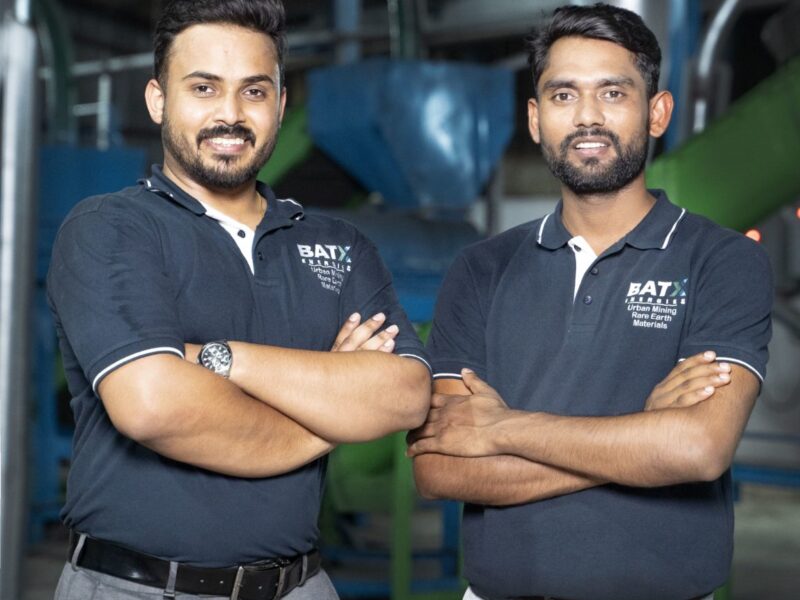

BatX Energies is a Gurugram-based deep-tech materials company that recovers battery-grade critical minerals from end-of-life lithium-ion batteries. Founded in 2020 by Utkarsh Singh and Vikrant Singh, both engineering graduates of BML Munjal University, the company operates physical recycling infrastructure rather than functioning as a waste broker or trading intermediary.
The company’s core process is an indigenously developed, low-temperature, low-pressure hydrometallurgical technology that is agnostic to battery chemistry, handling NMC, LFP, LCO, and mixed lithium-ion streams across pack, module, prismatic, cylindrical, and pouch form factors. The process runs in two stages: mechanical preprocessing that produces “black mass,” followed by hydrometallurgical refining that extracts battery-grade lithium carbonate, cobalt sulphate, nickel sulphate, and manganese carbonate.
BatX operates its primary Critical Minerals Extraction facility, HUB-1, in Sikandrabad, Bulandshahr district, Uttar Pradesh, alongside a corporate and engineering office in Gurugram, Haryana. The company follows a hub-and-spoke model, with a wider network of smaller collection and preprocessing facilities feeding the central hydrometallurgical hub.
Since its founding, BatX has scaled from a pilot operation into a commercial-stage recycler, securing government research support, institutional investment, and a growing set of industrial partnerships with electric vehicle manufacturers and battery producers. The company is also extending into rare earth magnet recycling and cathode active material development as adjacent lines of business.
BatX Energies directly advances SDG 9 through its indigenously developed and patented hydrometallurgical recycling infrastructure, built and engineered in-house rather than imported, and supported by India’s Technology Development Board for process commercialization. This reflects genuine investment in domestic industrial innovation and critical minerals infrastructure. SDG 12 is centrally relevant because the company’s entire business model is the recovery and reintroduction of lithium, cobalt, nickel, and manganese from spent batteries back into manufacturing supply chains, extending material lifecycles and reducing dependence on virgin extraction. SDG 13 applies because recovering battery metals through hydrometallurgical processing, rather than mining and pyrometallurgical smelting, is associated with materially lower energy intensity and emissions, directly supporting decarbonization of the battery and EV supply chain that BatX’s industrial customers depend on.
BatX’s methodology centers on an in-house, patented, chemistry-agnostic hydrometallurgical platform, developed over several years without reliance on imported recycling machinery. The process begins with discharge and stabilization of incoming cells and packs, followed by automated and semi-automated mechanical dismantling, shredding, and screening, which also recovers secondary materials such as aluminium, copper, steel, and plastics.
The resulting black mass, a concentrated intermediate containing lithium, cobalt, nickel, manganese, and graphite, is then processed through a dual-mode (wet and dry) recovery system before undergoing hydrometallurgical refining. This stage uses low-temperature, low-pressure chemical extraction rather than high-temperature pyrometallurgy, which the company states results in lower energy intensity and higher material selectivity. Recovery rates across the process are reported at 97 to 99 percent.
The entire technology stack, from collection logistics through downstream purification, has been developed and patented internally, with seven patent applications filed and two granted as of the company’s most recent public disclosures, and financial support for commercialization received from India’s Technology Development Board (Department of Science and Technology). BatX is also developing capabilities in cathode active material (CAM) production and, through a 2025 memorandum of understanding with Germany’s Rocklink GmbH, is extending its hydrometallurgical and solvent-extraction expertise into rare earth magnet recycling under the EU-India Trade and Technology Council framework.
BatX operates in India’s emerging lithium-ion battery recycling and critical minerals recovery sector, competing with players such as Lohum, Attero Recycling, and Metastable Materials. Its primary customers are electric vehicle OEMs, battery cell and cathode manufacturers, and industrial buyers of recovered lithium, cobalt, nickel, and manganese compounds. The company has secured a commercial partnership with VinFast India for high-voltage EV battery recycling and repurposing, positioning it within the supply chains of at least one global EV manufacturer’s Indian operations. Its differentiation rests on fully indigenous, patented process technology rather than licensed or imported recycling equipment, and on a hub-and-spoke facility model designed to reduce the logistics risk of transporting hazardous battery waste across India.
BatX Energies occupies a strategically significant position in India’s push for critical minerals self-reliance, addressing a genuine supply gap as the country’s electric vehicle and energy storage sectors scale faster than domestic mineral extraction capacity. The company’s emphasis on fully indigenous process development, rather than imported or licensed recycling technology, is corroborated across government, industry, and press sources, and its Technology Development Board backing lends some third-party validation to its technical claims.
Its commercial trajectory is notable: from pilot-stage operations in 2022 to a Series A round led by an institutional investor in 2026, alongside a named partnership with a global EV manufacturer’s Indian operations. The extension into rare earth magnet recycling, in partnership with a German specialist, suggests an ambition to broaden beyond lithium-ion batteries into the wider critical minerals recovery space.
That said, publicly available figures for total funding raised, patent counts, and lifetime batteries processed vary meaningfully across sources, and the company has not published independently audited operational or environmental performance data. Its claims of 97-99 percent recovery efficiency and near-total purity are consistent across company and press materials but are not verified by an independent third party in the sources reviewed. As with most young deep-tech recyclers, execution risk around scaling hydrometallurgical capacity while maintaining quality and safety standards remains a relevant consideration for partners and buyers.
75F is a building automation technology company that designs, manufactures, and operates an Internet of Things (IoT) based Building Management…
Ace Green Recycling, Inc. is a battery recycling technology company that develops proprietary, hydrometallurgical processes to recover critical materials from…

AgBoost Tech Consultancy (ATC) is an India-based geospatial and artificial intelligence technology firm that builds decision-support systems for the agriculture,…