

75F | IoT Building Automation & Energy Management
75F is a building automation technology company that designs, manufactures, and operates an Internet of Things (IoT) based Building Management…

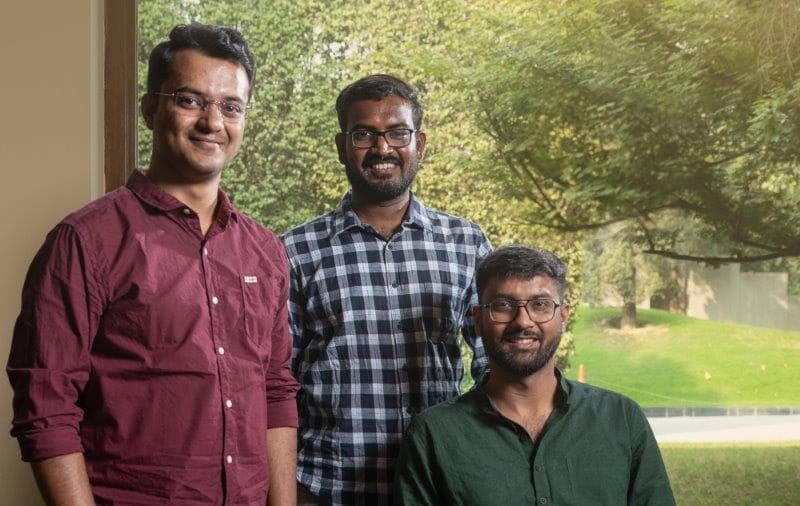
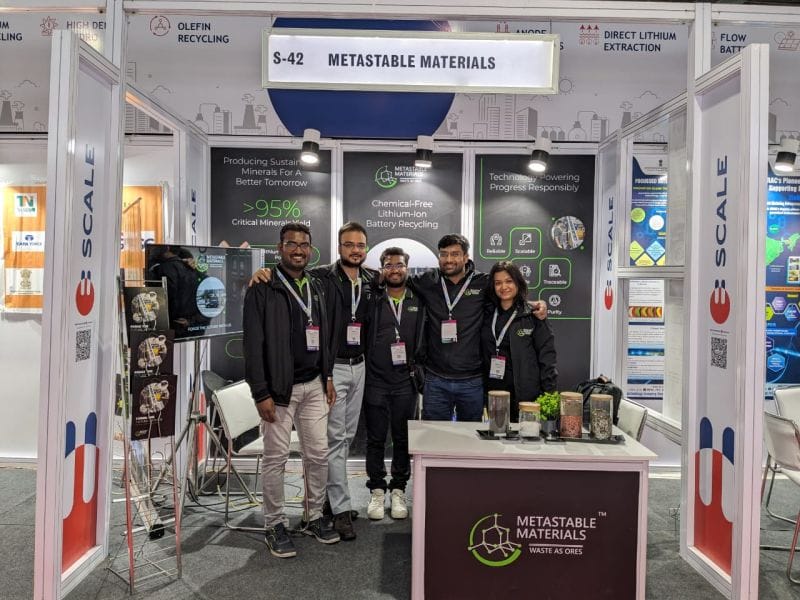
Metastable Materials is a Bengaluru-based deep-tech company that recovers critical metals from spent lithium-ion batteries and sells them as refined commodity products to industrial buyers. Incorporated in October 2021 by IIT Roorkee graduates Shubham Vishvakarma and Manikumar Uppala, the company positions itself as a raw material supplier and refiner rather than a conventional waste handler, treating battery waste as an ore-like feedstock for metal recovery.
At the core of its operations is a patented and trademarked process called Integrated Carbothermal Reduction, which the company describes as chemical-free. Batteries are dismantled under water to reduce fire and toxic gas risks, and the resulting reaction allows metals to be separated using physical properties such as density and magnetism rather than external chemical reagents.
The company operates two manufacturing facilities, a site in Bengaluru’s Harohalli Industrial Area and a second facility in Delhi chosen for proximity to battery feedstock supply. It designs and builds much of its own processing equipment in-house, including separators, agitators, furnaces, and shredders, and operates a zero-liquid-discharge water system.
Metastable has raised two funding rounds since its founding, a pre-seed round in January 2022 and a seed round in 2023, and has grown to a team of more than 50 employees. As of 2026, the company’s stated focus is scaling its processing capacity and expanding its facility footprint within India.
Metastable Materials directly supports SDG 12 by recovering critical metals from spent lithium-ion batteries and returning them to industrial supply chains rather than sending them to landfill or informal, unsafe processing. Its chemical-free extraction process and zero-liquid-discharge water system reflect the resource efficiency and reduced-waste-generation goals at the center of responsible consumption and production. The company’s stated aim of building circular supply chains for battery metals reduces dependence on virgin mining, extending the useful life of materials already in circulation. On SDG 13, recovering metals through a lower-energy, chemical-free process rather than conventional smelting or mining reduces the emissions intensity associated with sourcing critical minerals for batteries and other clean-energy applications, supporting the broader decarbonization of the battery and electric mobility value chain that the company’s customer base operates within.
Metastable Materials’ process runs end to end, from battery procurement and dismantling through to refining and metal recovery. Batteries are dismantled underwater, a method the company says eliminates the fire risk and toxic gas release associated with conventional mechanical crushing.
At the center of the process is Integrated Carbothermal Reduction, a patented and trademarked reaction in which materials inside the battery react with one another rather than with externally introduced chemicals. Once this reaction is complete, individual metals are separated using their physical properties: copper is recovered under pressure, lithium is dissolved in water, and nickel and cobalt are separated through magnetism.
The company has developed most of its production machinery in-house, including magnetic separators, density separators, agitators, boilers, furnaces, mills and shredders, and operates what it describes as one of India’s most compact zero-liquid-discharge systems, recycling process water on site. The company holds five patents relating to its extraction technology, including one international filing.
Before supplying at scale, Metastable works with individual customers to develop product specifications, such as acceptable contamination thresholds for particular end uses, reflecting a build-to-specification approach to industrial metal supply rather than a standardized commodity output alone.
Metastable Materials operates in India’s lithium-ion battery recycling and critical minerals recovery segment, competing with companies including Attero Recycling, Lohum, BatX Energies, Tata Chemicals, and Ace Green Recycling. Rather than serving the battery industry exclusively, its refined metal outputs are sold across multiple downstream industries: lithium to glass, ceramics, cement and grease manufacturers; nickel into the stainless-steel supply chain; cobalt into pigment and magnet manufacturing; copper into casting and bus bar production; and aluminium into automotive casting applications. Pricing is benchmarked against commodity exchanges including the London Metal Exchange, Shanghai Metal Exchange, MCX India, and the Bombay Metal Exchange, with final terms depending on purity, volume and customer relationships. The company began generating revenue in 2025 and has stated it is prioritizing capacity utilization and geographic expansion over the near term.
Metastable Materials addresses a structural gap in India’s battery supply chain: the country imports most of the critical metals used in battery manufacturing despite generating a growing volume of spent lithium-ion batteries domestically. By treating that waste stream as a recoverable ore source rather than a disposal problem, the company is positioned within a segment the industry increasingly views as strategically important as electric vehicle adoption accelerates.
Its differentiation rests on a chemical-free extraction claim and a build-your-own-equipment approach that has produced a compact zero-liquid-discharge system and five patents. Selling refined metals into diverse downstream industries, rather than only back into battery manufacturing, is a notable structural choice that broadens its potential customer base beyond the battery sector alone.
At the same time, the company remains an early-stage business. It has disclosed only two funding rounds to date, has not published independently audited figures for recovery rates or revenue, and its facility footprint remains limited to two sites. Its long-term significance will depend on whether it can scale processing utilization and expand capacity as it has stated it intends to, in a segment where several well-funded domestic and international competitors are also active.
75F is a building automation technology company that designs, manufactures, and operates an Internet of Things (IoT) based Building Management…
Ace Green Recycling, Inc. is a battery recycling technology company that develops proprietary, hydrometallurgical processes to recover critical materials from…

AgBoost Tech Consultancy (ATC) is an India-based geospatial and artificial intelligence technology firm that builds decision-support systems for the agriculture,…