


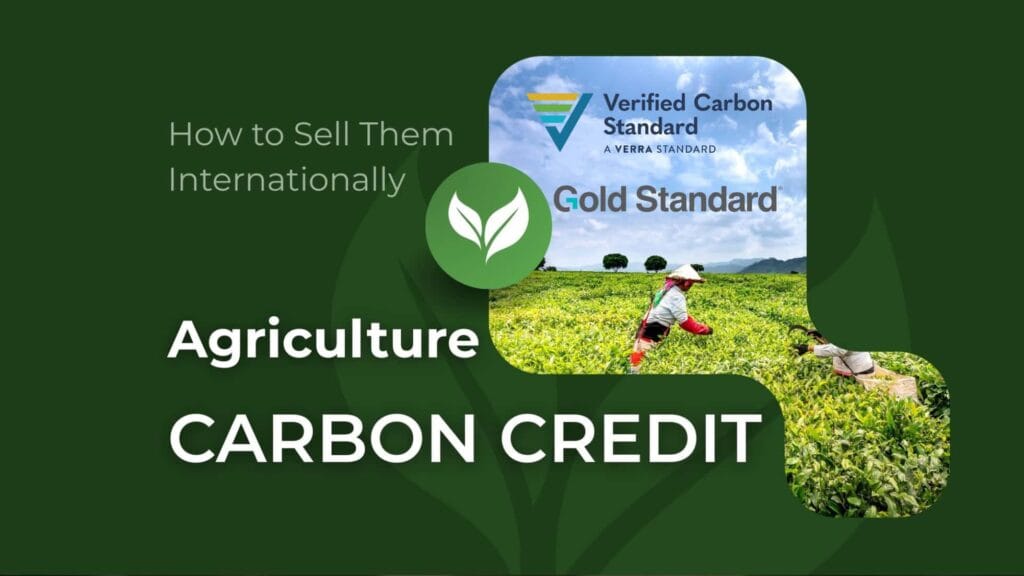
Agriculture is often missed as a climate solution. Most people think carbon credits only come from forests or renewable energy, but farms have a lot of unused potential.
The Intergovernmental Panel on the Climate Change (IPCC Assessment) says agriculture, forestry, and land use make up almost 24% of global greenhouse gas emissions. So, about one in four tonnes comes from this sector, showing why agricultural solutions are urgently needed.
When a farm adopts climate-positive practices, it can generate measurable and verifiable carbon benefits that global buyers are willing to pay for.
For instance, a group of farmers in Maharashtra implemented regenerative agriculture techniques and successfully sold carbon credits on the international market. Their project involved using cover cropping, reduced tillage, and agroforestry, which not only enhanced soil health but also sequestered significant amounts of carbon.
This success story shows that with the right practices and methodologies, Indian farms can capitalise on the carbon market.
A carbon credit represents one ton of carbon dioxide equivalent that has been reduced or removed from the atmosphere.
Farms can earn credits by storing more carbon in the soil, cutting methane emissions, or adding new plants through agroforestry. Some also make biochar, which stores carbon for a long time.
International buyers are increasingly looking for nature-based credits because they want solutions that deliver both climate and community impact.
The voluntary carbon market crossed $2 billion in annual transactions in recent years, driven largely by nature-based solutions reported by the Ecosystem Marketplace.
India is emerging as a leading hub for agriculture and land-based carbon projects. Hundreds of Indian projects are already listed under Verra and Gold Standard, which can be verified on the Registries.
Digital MRV tools and mobile apps make it easier to monitor large groups of farmers. This increases the credibility and scalability of Indian agricultural projects.
Agricultural carbon credits offer climate benefits, higher soil fertility, long-term resilience and additional income for rural communities.
This guide explains exactly how an Agricultural Carbon Project moves from concept to International carbon trading.
Understanding International Credits and Domestic Schemes
There are two major carbon frameworks relevant to Indian agriculture. The international voluntary carbon market and India’s domestic carbon programs.
International buyers only accept credits from globally recognised standards such as Verra VCS, Gold Standard, ACR, CAR and Plan Vivo. These standards follow strict methodologies, transparent registries and independent audits.
India’s domestic schemes operate separately. The Carbon Credit Trading Scheme and the Green Credit Programme are designed for national goals. They do not automatically produce internationally tradable credits.
High integrity buyers follow global guidelines established by the Integrity Council for the Voluntary Carbon Market. Their criteria ensure credits meet strong principles of quality and additionality, which are detailed in the IC VCM Core Carbon Principles.
If your project aims to sell credits internationally, it must follow voluntary market rules from the beginning.
Domestic credits cannot replace these standards.
Understanding the difference is the first major step for anyone planning to generate and sell agricultural credits.
Types of Agricultural Projects That Work for Carbon Credits
Agriculture offers multiple pathways for measurable carbon benefits.
Agroforestry and afforestation add biomass to farm landscapes and enhance long-term carbon storage.
They improve biodiversity, stabilise soils and provide additional income from timber or fruit.
Soil carbon projects depend on regenerative practices such as reduced tillage, crop residue retention and cover cropping.
Healthy soils store more carbon and improve water retention.
Rice methane reduction is one of India’s biggest opportunities. Alternate wetting and drying irrigation can reduce methane emissions by up to 48% according to research by the International Rice Research Institute.
Biochar offers long-term carbon storage because the carbon remains stable for hundreds of years. The climate potential of biochar is highlighted in the World Bank Biochar Report.
Each registry has strengths that affect which project type you choose.
Verra VCS supports a wide range of land use and agriculture methodologies and has the highest global liquidity. This means there are many active buyers for Verra credits.
Gold Standard offers fewer agricultural methodologies but focuses heavily on community impact and sustainable development. Projects that demonstrate social benefits often get better pricing here.
ACR and Plan Vivo are strong for soil carbon, smallholder systems and community-driven models. They are often used for farmer-led projects that want simplicity and strong social credibility.
A good thumb rule is to choose a project type that aligns naturally with existing farming practices, then expand it with proper methodology alignment.
Choosing the right project type ensures the project remains feasible, scalable and attractive to buyers.
Step 1: Define Your Agricultural Carbon Project and Match It With a Methodology
A methodology is the rulebook your project must follow based on the international standards. It explains how carbon benefits are calculated, how data is collected and how auditors will verify results.
Alignment with a methodology begins before any field activity. Tree planting, regenerative practices or biochar applications must match the methodology exactly. If the project does not follow a valid methodology from the start, it cannot generate internationally tradable credits later.
This is where many Indian projects go wrong. They start planting trees or changing practices without aligning with a methodology. Later, during validation, auditors rejected the project because the activities were not tracked or documented correctly.
Agroforestry methodologies describe how biomass is measured and how long trees must remain on land.
Soil carbon methodologies describe sampling depth, frequency and data requirements.
Rice methane methodologies focus on irrigation cycles, flooding days and fertiliser use.
Biochar methodologies require documentation of feedstock sources, pyrolysis conditions and application rates.
Most Indian agricultural projects operate as grouped projects because small farms cannot individually bear validation or verification costs. Grouped structures allow hundreds or thousands of farmers to join under a unified system.
Typically, a viable grouped project includes a minimum of 200 farmers or an acreage of around 500 hectares. This ensures that the costs of validation and verification are effectively distributed, making the project feasible and sustainable.
A simple way to choose the right methodology is to look at three factors.
- What activities are realistic for the farmers based on their land, water, time and crop cycles?
- Which methodology has clear guidance that fits this activity?
- Whether the expected carbon volume will justify the long-term effort.
When these three align, the project has a strong foundation.
Selecting the methodology early avoids costly redesigns later. It also sets clear expectations for monitoring and data collection.
Step 2: Selecting & Working With a Project Developer
For most farmers and agri-entrepreneurs, partnering with a project developer is the single most important decision in the entire carbon credit journey.
A project developer manages everything from technical design to long-term MRV. Their role begins with feasibility assessments and carbon modelling.
Developers prepare the Project Design Document (PDD), coordinate baseline studies, design sampling plans and build the monitoring framework.
They also manage audits, registry submissions, credit issuance and sales.
Most developers follow a revenue-sharing model, covering upfront costs and recovering them through future credit sales. This allows small and medium farmers to participate without financial risk.
Choosing the right developer is essential. Before signing with a developer, a few questions can save years of trouble.
- How many agricultural projects have they completed?
- How many credits have they issued?
- Do they own or outsource MRV?
- What percentage of revenue goes to farmers?
- How long is the contract?
- Who owns the data?
- How is transparency ensured during credit sales?
A credible developer builds trust and ensures the project remains stable over several years.
Step 3: Baseline Studies and Preparing Project Design Document (PDD)
Before a carbon project can be validated or registered, it needs a clear understanding of what the land currently looks like and how it performs under business-as-usual conditions. This starting point is called the baseline.
Baselines rely on real field data. This may include soil samples, biomass measurements, irrigation logs or historical land use records, depending on the project type.
Indian agricultural data from institutions like the Indian Council of Agricultural Research (ICAR) and the Central Research Institute for Dryland Agriculture (CRIDA) is extremely useful for building scientifically credible baselines.
Once the baseline is established, the next step is preparing the Project Design Document (PDD).
A good PDD describes the land area included in the project, how farmers are enrolled, what activities will be implemented and how these activities will generate measurable climate benefits.
It includes carbon calculations using formulas defined in the methodology.
It also explains assumptions and justifies why they are conservative. This is important because international standards prefer conservative estimates to ensure no project overclaims its benefits.
Safeguards are another important part of the PDD. Agricultural projects must show that they do not harm local communities, water resources or biodiversity.
The PDD addresses these concerns by describing potential social or environmental risks and how the project will manage them.
If the project involves planting trees, the PDD will explain how species were selected and how long-term permanence will be maintained.
If soil carbon is included, the PDD will describe how farmers will sustain the regenerative practices over time.
The PDD also outlines the monitoring system. It explains what data will be collected, how often sampling will take place, what tools will be used and how the developer will ensure consistency across all participating farms.
For grouped projects, the PDD describes how new farmers will be added over time, how training will be conducted and how quality control will be maintained.
A well-designed baseline and PDD reduce risks, improve credibility and create confidence for both auditors and international buyers.
Step 4: Validation and Registration With an International Standard
Validation is the independent audit that checks whether the project design follows the standard. This audit is carried out by a Validation and Verification Body that is approved by Verra, Gold Standard or whichever registry the project is using.
Auditors review all documentation, examine assumptions and inspect project sites.
They verify that the baseline is accurate, the methodology is correctly applied, and the monitoring plan is feasible.
They may request clarifications or revisions, known as corrective action requests.
After all issues are resolved, the project receives a validation report. It is then submitted for registration.
The project documents, validation report and supporting files are submitted to the registry.
After review, the project is published on the registry platform.
Registration marks the project’s formal entry into the international carbon market. A registered project with a strong PDD and a transparent structure tends to attract more interest when credits are eventually issued.
Step 5: Implementation and High Integrity MRV on the Farm
Implementation begins once the project is registered.
Farmers start adopting the approved activities such as planting trees, modifying irrigation or applying biochar. These activities must match what was approved during validation because any deviation can affect the carbon calculations later.
Monitoring, reporting and verification, often called MRV, is the backbone of any international carbon project.
Monitoring begins on the first day of implementation.
It includes GPS mapping, field logs, soil sampling, biomass measurements, satellite observations and digital record keeping.
Reporting happens at fixed intervals defined by the methodology and the registry. The project developer prepares a monitoring report that summarises the activities carried out, presents the data collected and calculates the carbon benefits achieved during the monitoring period.
Verification is an independent audit where auditors confirm that the claimed carbon benefits actually occurred.
Only after successful verification can credits be issued.
Digital MRV systems help maintain accurate and transparent records. They reduce human error and support large-scale monitoring across thousands of farms.
High integrity MRV builds trust, improves pricing and ensures long-term credibility.
Step 6: Credit Issuance and International Trading
Once verification is approved, the registry issues carbon credits into the project’s account.
Each credit receives a unique serial number for complete traceability.
Credits can be sold directly to corporates, climate funds or through intermediaries such as brokers.
Digital marketplaces and carbon exchanges are also becoming more popular. These platforms offer transparent pricing, standardised trading and wider buyer access. They can be helpful for smaller batches or projects that want to sell credits gradually instead of finding a single buyer for a large volume.
Removal‑based credits, such as agroforestry or biochar, often attract higher prices because they physically store carbon, as highlighted by Abatable’s analysis of carbon credit prices.
Geography and vintage both affect carbon credit prices, with buyers often favouring newer credits from regions that match their market or supply chain.
Forward-offtake agreements allow projects to secure early financing by selling future credits in advance.
Credits are retired once the buyer claims them for climate commitments. Retirement ensures they cannot be reused or double-counted.
The ability to issue and trade credits internationally is what makes high-integrity carbon projects sustainable over the long term.
Economics and Risks for Farmers and Aggregators
The financial side of agricultural carbon projects is often misunderstood. Many farmers expect quick income, while some project owners assume carbon revenue will cover all costs immediately.
Carbon projects involve design costs, sampling, validation, monitoring and verification. Grouped projects help distribute these costs effectively.
Revenue depends on credit volume, project type, geography, co-benefits and market conditions. Removal credits often command higher prices because of long-term climate impact.
Key risks include permanence challenges from drought or fire, policy changes, market fluctuations and inconsistent farmer participation.
Clear benefit-sharing agreements and transparent payments build trust and ensure farmers stay committed.
Well-managed projects become long-term income sources that strengthen rural resilience and support sustainable farming.
Checklist for Farmers and Agri Entrepreneurs
- Define the project goal and choose a global standard early.
- Select a project type that matches your land and climate.
- Partner with an experienced project developer.
- Create clear agreements and commitments with farmers.
- Map all plots and set up monitoring systems from day one.
- Collect accurate data and maintain consistent records.
- Follow the methodology without deviation.
- Prepare for long-term monitoring and periodic audits.
- Explore corporate buyers, brokers and marketplaces.
- Prioritise transparency and high integrity throughout the project.
Agricultural carbon credits unlock climate impact, new revenue and sustainable rural development.
With proper planning and strong execution, Indian farms can become global leaders in nature-based climate solutions.






So many doubts cleared, Thank you.