



Impact investing in startups is no longer driven by purpose narratives alone. It is increasingly shaped by data, accountability, and measurable outcomes.
Capital is moving toward businesses that can clearly demonstrate their environmental and social performance, not just describe it. For startups, this shift is redefining what it means to be investment ready.
Table of Contents
Investors today expect more than vision. They expect structured impact metrics, consistent reporting, and transparency that aligns with evolving ESG expectations.
This changes the role of impact investing completely. It is no longer just a funding category. It is becoming a framework through which startups are evaluated, compared, and scaled.
This article explores how impact investing works in practice, what investors actually look for, and why ESG reporting is becoming central to funding decisions for modern startups.
What is Impact Investing for Startups?
Impact investing for startups refers to making investments in companies, nonprofits, or ventures that generate beneficial social or environmental effects along with financial gains.
The seeds of this kind of investing were sown in the early 2000s. Ever since, it has witnessed an exponential surge. Presently, a multitude of investors channel their funds to back the causes they are passionate about.
Today, this definition is evolving beyond intent. Investors are increasingly evaluating impact through structured ESG data rather than broad mission statements.
Types of Impact Investing for Startups
Impact investments may take different forms, and therefore, understanding these types can help startups to learn what investors expect from them.
Environmental impact investment: This can be through supporting solar and wind companies, sustainable agriculture, water purification, and the recycling industry.
The report by CPI entitled Global Landscape of Climate Finance 2023 stated that annual climate finance flows had reached a record $1.3 trillion, almost twice the figure for previous years. Although the multiyear compound growth is very high, specific sub-sectors or regional climate impact investments have been reported to be in the 30-40% growth range.
Social impact investment: Socially focused impact investments refer to sectors such as healthcare, education, housing at affordable prices, and services that provide access to financial tools to low-income communities.
According to the Global impact investing network report, 68% of social impact investors are focused on social issues.
Community development impact investment: This could be low-income neighbourhoods, rural areas, and developing countries.
Why Impact Investing Matters for Startups
Impact investing is no longer driven by narrative alone. It is increasingly shaped by data, transparency, and measurable outcomes.
For startups, this changes the game completely.
Investors are not just looking for ideas that “do good”. They are evaluating how clearly a startup can define, track, and report its environmental and social impact. This is where ESG alignment becomes a critical factor.
Startups that integrate ESG metrics early are better positioned to attract serious capital. They are able to demonstrate not just intent, but accountability. This reduces investor risk and builds long term credibility.
The shift is visible across global capital markets. Funding decisions are increasingly influenced by structured impact data, not just storytelling. Startups that fail to quantify their impact often struggle to compete, even if their mission is strong.
In practical terms, this means impact investing is no longer just a funding opportunity. It is a signal that startups must operate with the same level of data discipline as larger enterprises.
Those who understand this early gain a clear advantage in capital access, partnerships, and long term growth.
What Impact Investors Look for in Startups
Impact investors are evolving from narrative driven decision making to data driven evaluation.
Startups are now assessed across three interconnected layers, mission clarity, measurable impact, and operational transparency.
Clear mission still matters, but it is no longer enough on its own. Investors expect startups to define the exact problem they are solving and how it connects to broader sustainability goals such as climate action, resource efficiency, or social inclusion.
Measurable impact has become the core filter. Investors want structured metrics. This includes carbon reduction, resource savings, access created, or any quantifiable outcome linked to the business model. Vague claims are no longer acceptable.
Business viability remains non negotiable. Impact without a scalable and sustainable revenue model does not attract long term capital. Investors expect a clear path to growth.
Scalability is evaluated not just in market terms, but in impact replication. Can the model scale without diluting its environmental or social outcomes?
Finally, data transparency is emerging as a decisive factor. Startups that can track, report, and communicate their ESG performance consistently stand out. This is where early adoption of reporting systems becomes a strategic advantage.
In today’s landscape, the strongest startups are not just impactful. They are measurable, reportable, and comparable.
Where to Find Impact Investors
Access to impact investors is no longer just about knowing where to look. It is increasingly influenced by how clearly a startup can present its ESG performance and impact data. Visibility and credibility are now closely tied to data transparency.
Impact investor networks: Be a member of an organization such as the Global Impact Investing Network (GIIN), Toniic, or Social Venture Circle. These networks link startups with investors.
Impact-driven venture capital companies: Companies such as DBL Partners, Omidyar Network, and Acumen are devoted to impact investments. Find out which ones are suitable for your field and stage.
Family offices: Rich families are more and more desirous of their investments to be in line with their values.
Many family offices now actively allocate capital to impact investing strategies.
Crowdfunding websites: Platforms such as Kiva, StartSomeGood, and Republic allow you to collect small amounts from numerous impact-oriented people.
Pitching contests: There are funding and publicity opportunities at events such as the Hult Prize, Echoing Green Fellowship, and local impact startup competitions.
Government schemes: A lot of social enterprises get grants and subsidized loans from governments. Look at your local economic development agencies.
While these categories define where capital flows, investor decisions within each category are increasingly driven by measurable ESG outcomes rather than broad sector alignment.
Impact Investing for Startups: Common Mistakes to Avoid
Here are the following common mistakes that should definitely be avoided;
Mistake 1: Focusing Only on Impact
The organization needs to establish a mission that will not restrict its ability to gather funding. The two elements of impact and profitability must coexist.
Mistake 2: Inflating Impact Claims
Exaggerated metrics destroy trust. Most impact investors verify data.
Mistake 3: Ignoring Competition
Businesses that declare they have no competitors demonstrate their failure to comprehend the market space. Every problem has alternatives.
Mistake 4: Asking for the Wrong Amount
Funding requests must align with stage and market norms. Misaligned funding expectations can raise concerns and reduce investor confidence.
Mistake 5: Unclear Use of Funds
The investors require organizations to present detailed plans about their capital spending. Detailed budgets improve confidence.
Impact Measurement and Reporting
Impact measurement is no longer a supporting activity. It is becoming a core requirement for accessing serious capital.
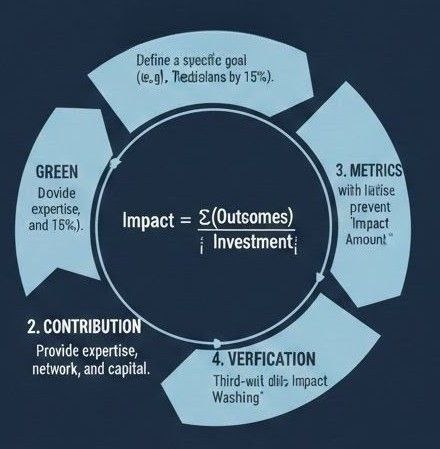
Investors today expect startups to move beyond qualitative claims and provide structured, comparable data. This shift is driving the adoption of ESG reporting practices even at early stages.
Startups need to define metrics that directly connect to their business model. For example, a climate focused startup may track carbon emissions reduced, energy saved, or waste diverted. A social impact startup may measure access created, income uplift, or service reach.
However, raw metrics alone are not enough. Standardization is what makes data meaningful to investors.
Frameworks such as the Sustainable Development Goals, IRIS+, and emerging ESG reporting standards allow startups to align their impact with globally recognized benchmarks. This improves credibility and makes evaluation easier for investors.
Consistency is equally important. Impact data must be tracked over time and reported regularly. Investors are increasingly expecting quarterly or structured updates, similar to financial reporting.
There is also a clear shift toward verification. As impact investing grows, investors are placing greater emphasis on data reliability. Startups that cannot validate their claims risk losing trust.
This is where digital tools and ESG reporting systems are starting to play a critical role. They help startups collect, structure, and communicate impact data efficiently, reducing manual effort and improving accuracy.
In practical terms, strong impact reporting does three things. It builds investor confidence, improves decision making, and positions the startup for larger funding rounds.
Startups that treat impact as data, not just narrative, are the ones that stand out in today’s investment landscape.
How to Build Long-Term Relationships with Impact Investors
In a data driven investment environment, relationships are increasingly built on transparency, consistent reporting, and performance visibility rather than periodic communication alone.
Receiving investment is only the starting point. Long term relationships drive continued capital access and strategic growth.
Communicate proactively: You shouldn’t wait for investors to request updates from you. Share progress, challenges, and success with regular email communications.
Ask for advice: Actively seek input from investors. Their experience and networks often provide strategic advantages beyond capital. Asking for help is a good way to make them feel involved and valued.
Don’t hide any problems from your investors: When your business has any problems, let your investors know the issues quickly.
They may be able to support you in solving the problems or at least appreciate your honesty.
Take your investors to witness your impact personally: If you can, let them come to meet the communities or customers you help.
Realizing impact in person is more powerful, and it makes commitment stronger.
Celebrate milestones together: When you achieve major goals, it is the right thing to do to involve your investors in the success. They are part of your team.
Why ESG Data is Becoming a Funding Filter
A major shift is happening in impact investing.
Investors are no longer asking whether a startup creates impact. They are asking whether that impact can be measured, verified, and compared.
This shift is turning ESG data into a funding filter.
Startups with clear, structured reporting are moving faster through due diligence. Their impact is easier to evaluate, which reduces uncertainty for investors. On the other hand, startups with unclear or inconsistent data face delays, additional scrutiny, or outright rejection.
This trend is especially visible in larger funds and institutional investors. As capital scales, decision making becomes more standardized. ESG data allows investors to compare opportunities across sectors and geographies.
It also aligns with regulatory trends. Sustainability disclosures are becoming more structured globally, and investors are preparing for stricter reporting expectations.
For startups, this means one thing. ESG readiness is no longer optional.
Those who invest early in building data systems and reporting processes position themselves as credible, investment ready businesses. Those who delay often struggle to meet investor expectations later.
In the near future, ESG reporting will not be seen as an additional effort. It will be a basic requirement for accessing capital.
Final Words
Impact investing is evolving into a data-driven discipline.
Startups are no longer evaluated only on mission and market potential. They are assessed on how effectively they can measure, report, and validate their impact alongside financial performance.
This shift is redefining funding readiness. ESG data is becoming a core part of due diligence, not an additional layer. Investors expect clarity, consistency, and comparability in how impact is communicated.
For startups, this creates both a challenge and an opportunity. Those who build structured reporting systems early can position themselves as credible, investment-ready businesses. They move faster through evaluation, attract stronger partners, and scale with greater confidence.
Those who rely only on narrative often struggle to meet the expectations of modern capital.
In the coming years, impact will not be judged by intention alone. It will be judged by data.
Startups that understand this shift early will not just access capital more easily. They will define how the next generation of sustainable businesses is built and scaled.
FAQs
What makes a startup investment ready in an ESG driven environment?
Investment readiness is increasingly defined by the ability to present structured ESG data alongside financial performance. Startups need clear impact metrics, consistent reporting, and alignment with recognized frameworks to meet investor expectations.
Why is ESG reporting important for early stage startups?
ESG reporting helps startups move from narrative to measurable impact. It improves credibility, reduces due diligence friction, and allows investors to evaluate opportunities more efficiently.
Do impact investors prioritize returns or impact?
Both. Modern impact investing integrates financial performance with measurable outcomes. Investors expect scalable business models supported by verifiable ESG data.
How do investors evaluate impact across different startups?
Investors rely on standardized frameworks and comparable metrics. This allows them to assess performance across sectors and geographies, making ESG data consistency a key requirement.
When should startups start building ESG reporting systems?
As early as possible. Early adoption creates a structured data foundation, making it easier to scale, attract capital, and meet future regulatory expectations.