



Companies across industries are under pressure to reduce their environmental impact while staying profitable. One tool gaining momentum is Material Flow Cost Accounting (MFCA). Unlike traditional accounting systems that only track financial transactions, MFCA connects material and energy flows with their associated costs, making inefficiencies visible and measurable.
Table of Contents
This approach not only helps reduce waste and improve resource efficiency but also directly contributes to lowering a company’s carbon footprint.
What is MFCA?
Material Flow Cost Accounting (MFCA) is a method within Environmental Management Accounting that tracks the physical flow of materials and energy alongside their financial value.
It measures inputs and outputs in physical units like kilograms or liters and links them to costs.
Unlike traditional accounting, it does not stop at finished products.
It also tracks waste.
This approach is formalised under ISO 14051, which makes MFCA a globally recognised standard for organisations looking to strengthen compliance, reporting, and audit readiness.
At its core, MFCA separates production into two categories.
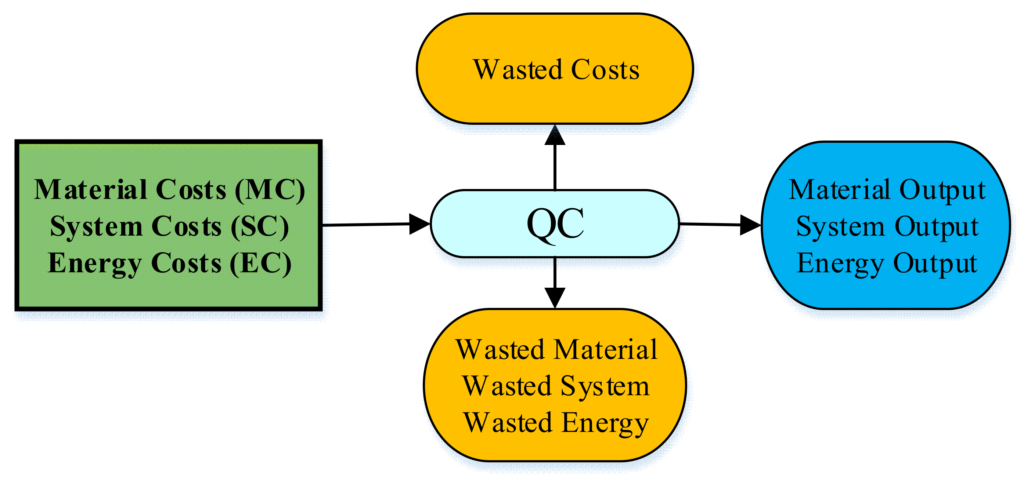
- Intended output – finished products
- Unintended output – waste, by-products, or inefficiencies
By assigning costs to both categories, MFCA reveals the hidden financial and environmental burden of waste.
This unintended output is where most businesses lose money without realising it.
The Hidden Cost of Waste Through Non-Product Output
In MFCA, waste is not treated as a secondary issue.
It is defined as Non-Product Output (NPO).
This is a critical shift in thinking.
Traditional accounting systems usually treat waste as either having no value or simply a disposal cost.
MFCA challenges that assumption by attaching real financial value to it.
Non-product output includes not just lost material, but also the energy used to process that material, the labor involved, and the overhead costs tied to production.
For example, if a defective unit is produced in a factory, the loss is not limited to raw material.
It also includes the electricity used in production, machine time, and workforce effort.
This is where MFCA becomes powerful. It reveals that waste is not just an environmental issue.
It is a direct financial loss embedded in operations.
Why MFCA Matters for Sustainability and Profitability
Traditional accounting systems often overlook the real cost of material losses and excess energy use. MFCA closes this gap by showing companies how inefficiencies increase both expenses and emissions.
This allows businesses to:
- Improve resource efficiency
- Reduce operational waste
- Align financial performance with sustainability goals
- Strengthen internal decision-making
But the real advantage goes beyond operational improvement.
MFCA changes how businesses think about value.
Instead of seeing waste as unavoidable, it positions it as something measurable, manageable, and reducible.
Traditional Accounting vs MFCA Approach
The difference between traditional cost accounting and MFCA is not just technical.
It is strategic.
In traditional systems, waste is often recorded as a minor cost or ignored altogether.
In MFCA, waste is treated as a combination of lost material cost, lost energy cost, lost labor, and overhead.
This shift forces organisations to recognise that inefficiency directly affects margins.
When leadership sees waste in financial terms, it moves from being a sustainability issue to a business priority.
The Business Case for MFCA: Cost and ROI
For any business leader, the key question is simple.
What does it cost, and what do we gain?
Implementing MFCA requires an initial investment.
This can include mapping material and energy flows, integrating data into existing accounting or ERP systems, and training teams to work with both physical and financial data.
Some organisations also invest in software tools to enable real-time tracking.
However, the returns are often significant.
Companies that adopt MFCA typically see measurable reductions in material waste, often in the range of 10% to 30%.
Energy costs decrease as inefficient processes are identified and optimised.
Production efficiency improves, leading to better margins.
Beyond direct cost savings, MFCA provides strategic value.
It enables more accurate product costing, improves pricing decisions, and strengthens sustainability reporting.
In this sense, MFCA is not just a cost reduction tool. It is a profitability driver.
Pre-MFCA vs Post-MFCA: Where the Real Value Emerges
Understanding MFCA becomes much easier when you compare how decisions are made before and after its implementation.
Most organisations already have cost and production data. The problem is not the absence of data. It is the lack of visibility and connection between systems.
Before MFCA, waste exists across operations but remains partially hidden.
- Material losses are recorded, but not fully costed
- Energy usage is tracked, but not linked to inefficiencies
- Waste disposal is treated as an isolated expense
- ESG reporting relies on estimates rather than process-level data
This creates a situation where inefficiencies exist, but their full financial and environmental impact is not visible.
After implementing MFCA, the same operations start telling a very different story.
- Every unit of material is tracked from input to output
- Non-Product Output is assigned full cost, including energy, labor, and overhead
- Waste is no longer a side metric, it becomes a core financial indicator
- Emissions can be linked directly to specific processes and inefficiencies
This shift transforms how decisions are made.
Instead of reacting to high-level cost trends, teams can identify exact points of loss within operations. Instead of estimating emissions, sustainability teams can work with traceable, process-level data. Instead of treating ESG as a reporting exercise, companies can use it as a decision-making system.
The result is not just cost savings. It is a structural improvement in how the business understands performance. This is where the real value of MFCA emerges.
It converts hidden inefficiencies into measurable, actionable insights that improve both profitability and ESG outcomes.
How MFCA Supports Scope 3 Emission Reduction
One of the biggest challenges in corporate sustainability is reducing Scope 3 emissions.
These emissions occur across the value chain and are often difficult to control.
MFCA provides a practical way to address this.
By reducing material waste within operations, companies reduce the need for upstream raw material production.
This has a direct impact on emissions generated during the extraction, processing, and transportation of materials.
In simple terms, using fewer materials means generating fewer upstream emissions.
This makes MFCA one of the most effective ways to reduce Scope 3 emissions without requiring major changes in suppliers or supply chain structure.
How MFCA Fits Into ESG Reporting Systems
MFCA is not just an operational efficiency tool.
It acts as a data foundation for ESG reporting systems.
Most companies struggle with ESG reporting not because of lack of intent, but because of poor data visibility across operations.
MFCA solves this by linking three critical layers:
- Physical data, material and energy flows
- Financial data, cost of inputs, waste, and inefficiencies
- Environmental data, emissions associated with each stage
This integration creates a structured dataset that can directly feed ESG disclosures.
For example, when waste is measured as Non-Product Output, it is no longer just an operational issue.
It becomes:
- A measurable cost inefficiency for finance teams
- A traceable emissions source for sustainability teams
- A reportable metric for ESG disclosures
This is especially relevant under frameworks like Corporate Sustainability Reporting Directive (CSRD) and IFRS S2, where companies are expected to provide auditable, decision-useful sustainability data.
MFCA helps structure this data at the source.
Instead of estimating emissions or relying on high-level averages, organisations can build bottom-up, process-level insights that improve both accuracy and credibility.
In this sense, MFCA is not just about reducing waste.
It is about enabling traceable, audit-ready ESG data systems.
Potential Challenges When Implementing MFCA
While MFCA offers strong financial and sustainability benefits, implementation is not always straightforward.
The biggest challenge is not the methodology.
It is the organisation’s data structure.
In most companies, data is fragmented across systems.
- Production teams track material and energy flows on the shop floor
- Finance teams work within ERP systems focused on cost and transactions
- Sustainability teams operate separately with emissions estimates and reporting tools
These systems rarely communicate in a structured way. This creates a gap.
Material loss may be visible in operations. Cost impact may be visible in finance. Emissions may be reported at a high level. But they are not connected.
MFCA requires these layers to be integrated. Without that integration, companies face common issues:
- Inconsistent data between departments
- Difficulty assigning accurate costs to waste streams
- Limited traceability for ESG reporting and audits
- Manual data reconciliation that slows decision-making
Another challenge is data granularity.
MFCA works best with process-level data.
Many organisations only have aggregated data, which reduces accuracy and limits insights. There is also an organisational challenge.
MFCA is often treated as a sustainability initiative. In reality, it requires alignment across:
- Finance
- Operations
- Sustainability
Without clear ownership and coordination, implementation efforts tend to stall.
These challenges highlight a key reality.
MFCA is not just a methodology. It requires a system capable of connecting operational, financial, and environmental data in real time.
Companies that overcome this gap move from static reporting to continuous, decision-ready insights.
Case Study: MFCA in the Wine Industry
A winery in Spain adopted MFCA to monitor its carbon footprint across the value chain. The project unfolded in six phases:
- Analyze energy use and emissions across the production and supply chain using Life Cycle Assessment (LCA).
- Link CO₂ emissions to products to calculate per-unit carbon intensity.
- Develop an online program for real-time emissions tracking.
- Engage stakeholders, including technical staff, cooperative farmers, and supply chain partners.
- Integrate the system with accounting and reporting tools.
- Report results through internal and external communication systems.
The outcomes were significant:
- Carbon reduction: Monitoring revealed high emissions from glass production, prompting targeted improvements.
- Operational efficiency: Inefficient machinery was repaired or replaced, reducing energy costs.
- Supply chain collaboration: Farmers gained insights into their energy use and became more engaged in sustainability.
- Market advantage: The winery could now label and report product-specific carbon footprints, strengthening its reputation in environmentally conscious markets.
This case shows how MFCA not only reduces emissions but also improves profitability and stakeholder relationships.
Why Cross-Functional Execution is Critical
One of the most common reasons MFCA initiatives fail is organisational structure.
Companies often treat it as a sustainability project.
In reality, MFCA requires coordination across multiple functions.
The finance team is needed to assign and validate costs.
The production team tracks material and energy flows in physical units.
The sustainability team ensures alignment with ESG goals and reporting frameworks.
If these functions operate in isolation, the system breaks down.
When they work together, MFCA becomes a powerful decision-making tool that connects operational data with financial outcomes.
This cross-functional alignment is not optional. It is the foundation of successful implementation.
Roles and Responsibilities in MFCA Implementation
MFCA implementation is not owned by a single team. It requires clear coordination across functions, with each role contributing a specific layer of insight.
Without defined responsibilities, data remains fragmented and decision-making slows down.
Here is how key roles typically align in an MFCA-driven system:
CFO or Finance Lead
- Validates cost allocation across material flows and waste streams
- Ensures that Non-Product Output is accurately reflected in financial terms
- Connects MFCA insights to profitability, pricing, and capital allocation decisions
- Aligns MFCA outputs with financial reporting and ESG disclosures
Operations Manager
- Tracks physical material and energy flows across production processes
- Identifies inefficiencies, leakages, and process-level waste
- Provides real-time operational data required for accurate MFCA modelling
- Works on process optimisation based on identified losses
Sustainability or ESG Lead
- Translates material and energy losses into emissions impact
- Aligns MFCA outputs with Scope 1, 2, and 3 reporting requirements
- Ensures consistency with frameworks such as CSRD and IFRS S2
- Prepares audit-ready sustainability disclosures based on MFCA data
IT or Data Team
- Integrates data across ERP systems, production systems, and sustainability tools
- Ensures data consistency, traceability, and accessibility
- Builds or manages systems that enable continuous tracking rather than one-time analysis
This structure highlights an important shift.
MFCA is not just a sustainability initiative.
It is a cross-functional data system that connects operations, finance, and ESG reporting.
When roles are clearly defined and aligned, MFCA moves from a one-time project to a continuous decision-making capability.
First Steps to Implement MFCA
Organisations looking to adopt MFCA should begin with visibility.
Start by mapping material and energy flows across operations.
Identify all inputs, outputs, and waste streams.
Quantify Non-Product Output in both physical and financial terms.
Build a cross-functional team that includes finance, operations, and sustainability.
Integrate MFCA into existing reporting systems so insights can be tracked over time.
The objective is not to achieve perfect data immediately.
It is to create a system that continuously improves understanding and performance.
MFCA as a Strategic ESG Finance Tool
MFCA is often introduced as a cost accounting method.
In reality, it functions as a decision system that connects operations, finance, and ESG reporting.
At its core, MFCA transforms inefficiencies into structured, measurable data.
This makes it directly relevant for both financial strategy and sustainability disclosures.
For finance teams, MFCA provides clarity on where value is being lost.
- Material inefficiencies become quantifiable cost drivers
- Energy waste is linked directly to operational decisions
- Non-Product Output is no longer hidden, it becomes a financial signal
This allows CFOs and finance leaders to move beyond aggregated cost views and work with process-level insights that improve margins and capital allocation.
For sustainability teams, the same data becomes the foundation for credible ESG reporting.
Instead of relying on estimates, emissions can be tied to specific processes and inefficiencies. This improves accuracy, strengthens audit readiness, and aligns with frameworks such as CSRD and IFRS S2.
But the real shift happens when these two perspectives come together.
MFCA enables organisations to treat sustainability not as a reporting obligation, but as a financial decision-making layer.
- Cost reduction and emissions reduction become aligned objectives
- Investment decisions can be based on both financial return and environmental impact
- ESG metrics move from static reports to continuous performance indicators
This is where MFCA moves beyond methodology. It becomes part of a broader system where:
- Operational data feeds financial analysis
- Financial data supports ESG disclosures
- ESG insights inform business strategy
Without this integration, companies rely on fragmented data and manual reconciliation.
With it, they gain a continuous, traceable, and decision-ready view of performance.
In this context, MFCA is not just a tool for efficiency. It is a foundational layer for building scalable ESG data and reporting systems.
From Compliance to Competitive Advantage
Sustainability is no longer just about meeting reporting requirements.
Frameworks like Corporate Sustainability Reporting Directive (CSRD) and IFRS S2 are pushing companies toward greater transparency, accuracy, and accountability.
But compliance alone does not create value. What creates value is the ability to understand, measure, and act on data continuously.
This is where MFCA changes the game. It connects what happens on the shop floor with what gets reported in financial statements and ESG disclosures.
- Material losses become visible.
- Cost leakages become measurable.
- Emissions become traceable.
This shift transforms sustainability from a reporting exercise into a core business capability.
Companies that adopt MFCA early move beyond reactive compliance.
They gain:
- Clear visibility into operational inefficiencies
- Stronger alignment between finance, operations, and ESG teams
- Data that supports faster, more confident decision-making
- A foundation for audit-ready, high-quality ESG reporting
Over time, this creates a compounding advantage.
Decisions are no longer based on assumptions or aggregated data.
They are based on process-level insights that link cost, performance, and environmental impact.
This is what separates companies that report sustainability from those that operate with it at the core of their strategy.
MFCA is not the final solution. It is the starting point.
A starting point for building systems that can continuously track performance, integrate data across functions, and turn sustainability into a measurable driver of business value.
In a landscape where ESG expectations are rising and margins are under pressure, that shift is not optional.
It is what defines the next generation of competitive businesses.