

75F | IoT Building Automation & Energy Management
75F is a building automation technology company that designs, manufactures, and operates an Internet of Things (IoT) based Building Management…

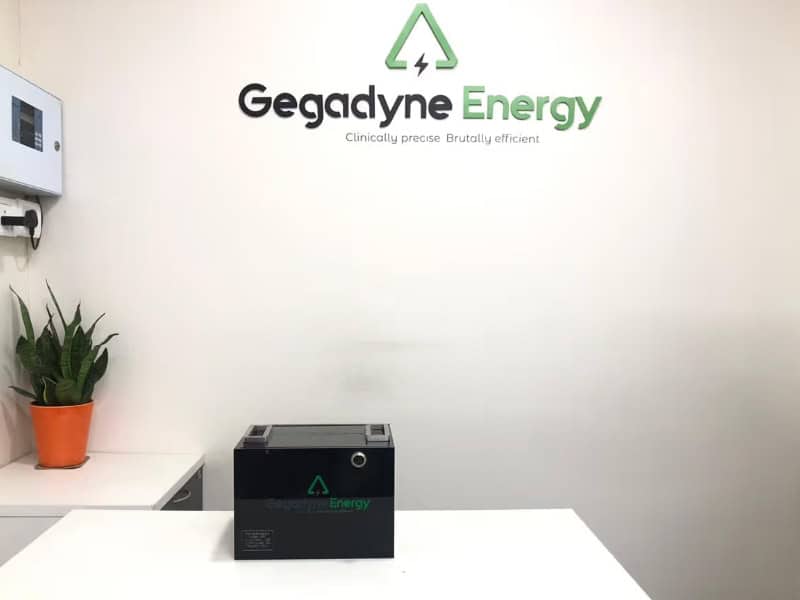
Gegadyne Energy is a Mumbai based deep tech battery technology company founded in 2015 by Jubin Varghese and Ameya Gadiwan. The company develops and manufactures Multi-Ion battery technology, a patented, lithium free chemistry built on a sodium potassium intercalation architecture rather than licensed international intellectual property.
The company’s core innovation addresses fast charging and cycle life limitations found in conventional lead acid and lithium ion batteries. Gegadyne’s battery packs are designed to charge from 0 to 100 percent within approximately 15 minutes and are rated for more than 5,000 charge cycles.
Gegadyne operates as a vertically integrated manufacturer. Its commercial product stack spans proprietary cell chemistry, customised battery packs, an in-house Battery Management System with cell level monitoring, integrated chargers, and a telematics layer for performance tracking.
In 2026, the company announced the commercial launch of its Multi-Ion technology for industrial and traction applications, including forklifts, order pickers, reach trucks, pallet jacks and cold storage equipment, with deployments already underway with European and Indian OEM customers.
The company is headquartered in Mumbai, Maharashtra, and operates under the registered legal entity Gegadyne Energy Labs Private Limited. It has raised institutional funding across multiple rounds, including a strategic investment from V-Guard Industries, an Indian consumer electricals manufacturer that has progressively increased its equity stake in the company.
Gegadyne Energy's work connects directly to three Sustainable Development Goals. SDG 7 is supported through the company's development of energy storage technology that enables more efficient use of electricity and supports the broader shift toward electrified industrial equipment and renewable integrated power systems. SDG 9 is relevant because Gegadyne represents domestic, in-house innovation in advanced battery chemistry, contributing to industrial infrastructure resilience and reducing reliance on imported battery technology for material handling and traction applications. SDG 12 applies because the company's lithium, cobalt and nickel free chemistry reduces dependence on scarce and geopolitically concentrated raw materials, while the long cycle life and extended warranty period of its batteries support more resource efficient consumption patterns across the industrial equipment lifecycle.
Gegadyne's approach centers on original, in-house battery chemistry research rather than licensing existing international battery technology. The company's engineering team developed a proprietary sodium potassium intercalation architecture, described as a dual-ion system in which multiple ion types work in parallel rather than relying on a single charge carrier as in conventional lithium-ion or lead-acid batteries.
This chemistry was developed and patented internally over several years of laboratory research and pilot scale testing before commercial launch. The company operates its own battery research facility and pilot manufacturing capability in Mumbai, which supports iteration on cell design, electrode materials and pack architecture.
Delivery to customers follows a vertically integrated model. Rather than supplying cells alone, Gegadyne engineers complete battery packs tailored to specific equipment classes, pairs them with its own Battery Management System for cell balancing and monitoring, and layers on telematics for operational data collection. This full stack approach allows the company to customise voltage and capacity specifications, currently spanning 24V to 84V packs with capacities up to 1,020 Ah, to match specific equipment categories such as counterbalance forklifts, reach trucks and pallet jacks. The company has also engineered a cold storage variant for extreme low temperature environments, indicating an application specific engineering methodology rather than a single standardised product line.
Gegadyne Energy operates in the industrial and traction battery segment, competing with established lead-acid battery suppliers and imported lithium-ion battery providers in the material handling and energy storage markets. Its primary customers are original equipment manufacturers and operators in forklift, warehouse, cold storage and industrial power sectors across India and Europe. The company positions its Multi-Ion chemistry as a domestically developed, patented alternative to both lead-acid and lithium-ion technologies, differentiated by its non-lithium composition, extended cycle life claims, and a seven-year product warranty. Strategic backing from V-Guard Industries, an established Indian electricals manufacturer, has provided the company additional capital and industry positioning within India's energy storage sector.
Gegadyne Energy represents a notable case of original battery chemistry development originating from India, a market that has historically relied on licensed or imported battery technology. The company's decision to build a lithium free chemistry from first principles, rather than adapting existing lithium-ion architectures, is a meaningfully different technical path from most energy storage entrants, and its patent position reflects genuine in-house research investment rather than integration of externally licensed IP.
The company's relevance to sustainability procurement lies primarily in supply chain diversification. By removing lithium, cobalt and nickel from its cell chemistry, Gegadyne offers industrial buyers an alternative less exposed to the price volatility and geopolitical concentration associated with conventional battery raw materials, while its extended cycle life claims point toward a lower lifecycle replacement burden for traction equipment operators.
At the same time, the company's recent commercial launch for industrial and traction applications, announced in 2026, indicates that large-scale deployment history is still developing relative to more established lead-acid and lithium-ion incumbents. Strategic investment from V-Guard Industries provides a degree of financial backing and market credibility, but procurement teams evaluating Gegadyne should weigh its technology's relative newness to market against its stated performance and cost advantages, and request independent verification of cycle life and safety claims where decision-critical.
75F is a building automation technology company that designs, manufactures, and operates an Internet of Things (IoT) based Building Management…
Ace Green Recycling, Inc. is a battery recycling technology company that develops proprietary, hydrometallurgical processes to recover critical materials from…

AgBoost Tech Consultancy (ATC) is an India-based geospatial and artificial intelligence technology firm that builds decision-support systems for the agriculture,…