
75F | IoT Building Automation & Energy Management
75F is a building automation technology company that designs, manufactures, and operates an Internet of Things (IoT) based Building Management…

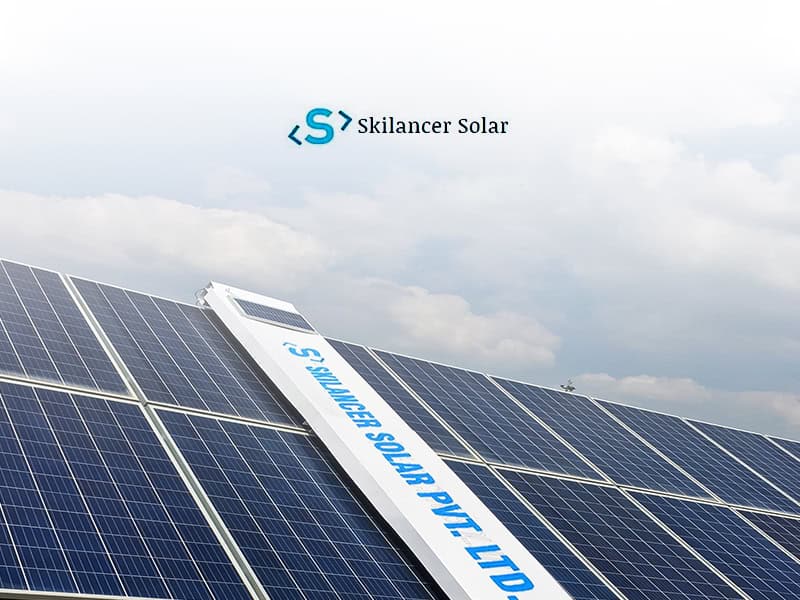
Skilancer Solar is an Indian manufacturer of robotic systems for cleaning solar photovoltaic panels without water. The company designs, builds, and deploys autonomous and portable cleaning robots, along with an optical soiling sensor, aimed at recovering the generation capacity that solar plants lose to dust accumulation.
The company was co-founded by Neeraj Kumar, an IIT Jodhpur alumnus, and Manish Kumar Das, an instrumentation engineer, and was incubated at the IIM Lucknow Enterprise Incubation Centre. It operates a manufacturing and R&D facility in the DLF Industrial Area of Faridabad, Haryana, where robots are assembled and quality-tested under ISO 9001:2015 certified processes.
Skilancer’s product range spans a fully autonomous crawler robot for utility-scale plants, a portable semi-automatic unit for decentralized and rooftop sites, a manually operated cleaning robot, an AI-enabled thermal inspection robot, and a standalone optical sensor that measures soiling levels on panel glass. Beyond hardware, the company offers turnkey solar EPC construction and ongoing operations and maintenance services.
Skilancer’s robots use a helical polybutylene terephthalate (PBT) brush that sweeps dust from panel surfaces using rotation and gravity, avoiding the water use and thermal-shock risk associated with manual wet cleaning. The robots are self-powered through onboard solar panels and lithium iron phosphate batteries and communicate with plant SCADA systems over LoRaWAN or cellular networks. The company has installed robots across multiple Indian states and reports client relationships with several large solar developers and industrial energy users.
kilancer Solar's waterless robotic cleaning directly supports SDG 6 by eliminating the water traditionally used to wash solar panels, an important consideration in the arid, high-irradiation regions where soiling losses are greatest. The company's core function, recovering lost solar generation, supports SDG 7 by helping existing renewable energy assets operate closer to their rated output without new capacity being built. Its role as an in-house designer and manufacturer of robotics, sensors, and telemetry hardware for the solar sector aligns with SDG 9, which recognizes the value of building resilient, innovation-driven industrial infrastructure. By keeping solar plants generating at higher efficiency, the company's technology also contributes to SDG 13, since better-performing solar assets displace a larger share of fossil-fuel-based electricity generation over their operating lifetime.
Skilancer Solar's approach centers on in-house design and manufacturing of its robotic hardware at its Faridabad facility, where units undergo dust and water ingress testing, motor and gearbox calibration, and battery cycle audits under ISO 9001:2015 quality procedures. The core cleaning mechanism uses a custom helical PBT micro-fiber brush, angled to combine high-speed rotation with gravity to displace dust from panel surfaces without contacting or scratching anti-reflective coatings.
Robots operate on an independent power loop, drawing from an onboard photovoltaic panel and lithium iron phosphate battery, so they do not draw power from the host solar plant. Positioning and navigation rely on RTK-corrected GPS for row-to-row movement, while onboard sensors track motor torque, wheel slip, and battery condition to flag maintenance needs before failure.
The company also runs a sensor-linked monitoring layer, in which its SS-Sense optical nodes use dual-wavelength light transmission measurement to quantify dust accumulation on module glass. This data is intended to trigger automated dispatch of cleaning robots once soiling losses cross an economic threshold, connecting sensing, decision-making, and physical cleaning into one operating loop. Cleaning and diagnostic data is transmitted to plant SCADA systems or a cloud dashboard over LoRaWAN or cellular connections, allowing remote scheduling and performance verification rather than manual, on-site inspection.
Skilancer Solar operates in India's solar operations and maintenance segment, specifically the niche of robotic dry-cleaning hardware, alongside other domestic players such as Aegeus Technologies, Greenleap Robotics, and Taypro. Its customers include independent power producers, EPC contractors, and large industrial energy users with captive or rooftop solar installations. The company positions itself around in-house manufacturing rather than imported or rebadged hardware, combining robot production, EPC construction, and ongoing O&M under one operating structure. Reported client relationships include several large Indian solar developers and manufacturing companies with rooftop solar assets.
Skilancer Solar addresses a specific and measurable operational problem in solar energy: dust-related generation loss, which can reach double-digit percentages in high-soiling regions of India. By replacing water-intensive manual cleaning with a self-powered, waterless robotic alternative, the company offers a technically differentiated response to a real constraint in water-scarce solar markets, an approach validated by its adoption across large-scale developer and industrial rooftop projects.
The company's decision to keep manufacturing in-house, rather than importing or licensing hardware, is a notable structural choice that supports its ISO 9001:2015 certification and gives it direct control over quality and after-sales support, both important considerations for buyers evaluating long-term O&M reliability. Its progression from a single cleaning robot to a broader stack that includes optical soiling sensors, AI-based thermal inspection, and SCADA-linked telemetry suggests a company building toward a more integrated monitoring and maintenance offering rather than a single-product business.
At the same time, Skilancer operates in a competitive and increasingly crowded segment, with domestic entrants such as Greenleap Robotics and international players like Ecoppia offering comparable dry-cleaning technology. Its funding scale, at roughly $1.59 million raised to date according to third-party trackers, remains modest relative to some competitors, which may be a relevant consideration for buyers assessing long-term vendor stability.
75F is a building automation technology company that designs, manufactures, and operates an Internet of Things (IoT) based Building Management…
Ace Green Recycling, Inc. is a battery recycling technology company that develops proprietary, hydrometallurgical processes to recover critical materials from…

AgBoost Tech Consultancy (ATC) is an India-based geospatial and artificial intelligence technology firm that builds decision-support systems for the agriculture,…