

Solar panels in commercial buildings, IT parks, and industrial facilities are not just energy systems, they are performance assets.
Their output directly affects energy costs, operational efficiency, and sustainability reporting.
Dust, pollution, and environmental buildup do more than reduce visibility. They reduce energy generation, often by 5% to 25% depending on location and exposure. For large-scale installations, this drop is not minor. It translates into measurable energy loss, cost inefficiencies, and gaps in expected performance.
Research by the National Renewable Energy Laboratory shows that even thin layers of soiling can consistently impact solar output if not managed properly, with studies highlighting measurable efficiency losses due to dust accumulation.
For businesses, this is no longer just a maintenance issue. It is an operational and reporting concern.
Solar performance influences energy consumption data, carbon accounting, and ESG disclosures. Inconsistent output leads to unreliable performance metrics, which affects how sustainability outcomes are measured and reported.
This guide breaks down how structured maintenance, monitoring, and system-level thinking can help businesses protect energy yield, maintain reporting accuracy, and optimize long-term solar performance.
The impact of solar performance on ESG reporting and compliance
In large-scale solar installations, performance is directly linked to sustainability metrics.
A drop in efficiency due to dust or poor maintenance does not just reduce energy output. It affects how renewable energy contribution is recorded and reported. For example, a 15% reduction in output due to soiling directly lowers the share of clean energy in total consumption.
This has implications for Scope 2 emissions reporting, where companies track indirect emissions from purchased electricity. If solar systems underperform, businesses rely more on grid electricity, increasing reported emissions.
In India, this also connects to Business Responsibility and Sustainability Reporting requirements, where companies disclose energy consumption, renewable energy usage, and efficiency improvements. Inconsistent solar performance can create gaps between installed capacity and actual contribution.
For businesses looking to implement structured maintenance, sourcing the right operations and maintenance partners is critical. Platforms like NatNavi Impact Hub can help identify and connect with verified solar O and M providers who specialize in large-scale and sustainability-aligned operations.
Surface Efficiency and Energy Yield Optimization in Commercial Solar Systems
In commercial solar installations, surface condition directly impacts energy yield.
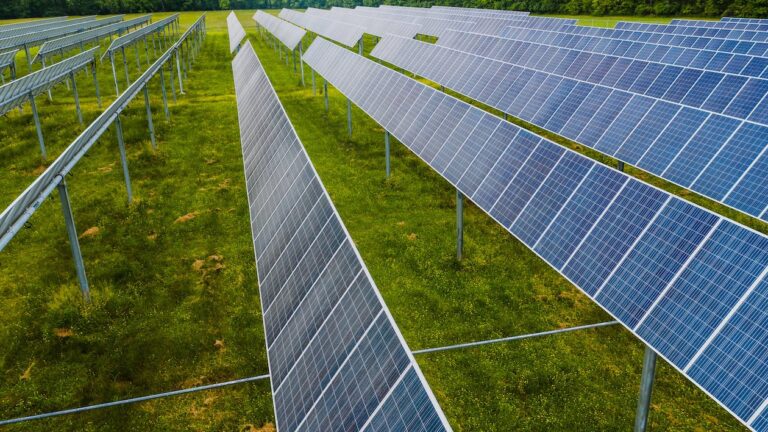
Dust, particulate matter, and environmental buildup create a thin barrier that reduces solar irradiance reaching the cells. Even minor soiling can lead to efficiency losses ranging from 5% to 25%, depending on site conditions such as pollution levels, proximity to industrial zones, and seasonal factors.
At scale, this is not a marginal loss. Across large rooftop systems or ground-mounted arrays, reduced efficiency translates into measurable drops in total energy generation, affecting both cost savings and expected return on investment.
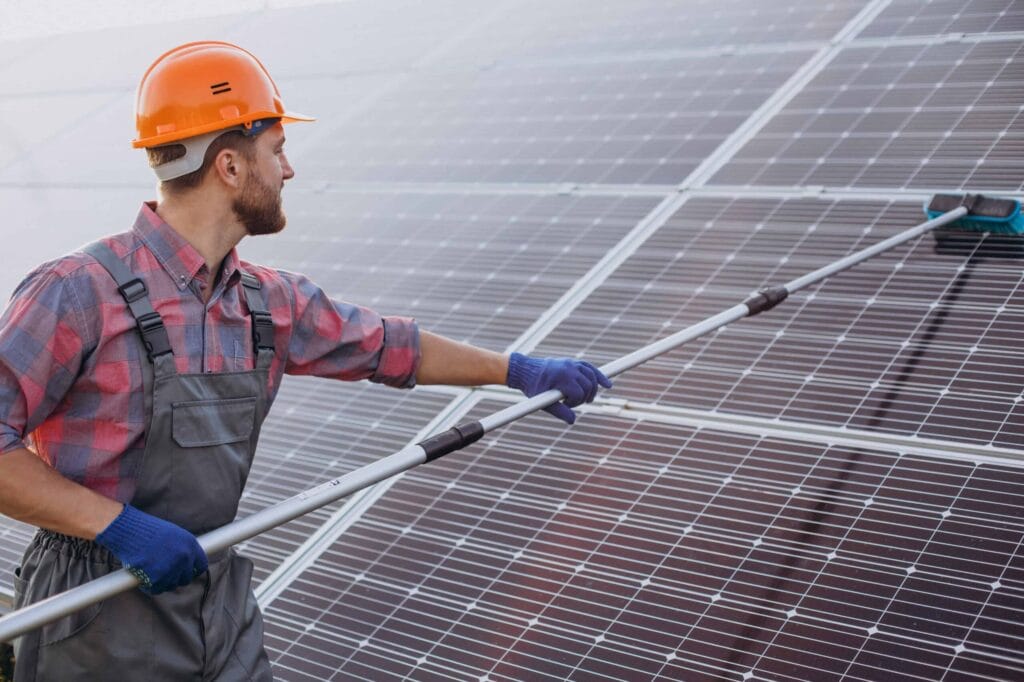
Manual cleaning is typically handled by trained operations teams or specialized vendors using deionized water systems, soft rotating brushes, or controlled-pressure cleaning methods designed to avoid micro-scratches and panel degradation. Safety protocols, including system shutdown procedures and access management, are standard practice in large installations.
In environments with high dust accumulation or water constraints, automated cleaning systems are increasingly deployed. Robotic dry cleaning systems are widely used in arid regions, while water-assisted systems are applied where deeper cleaning cycles are required.
The focus is not on occasional cleaning, but on maintaining consistent surface efficiency across the entire system lifecycle.
Sourcing Solar Operations and Maintenance Partners for Large Installations
In commercial solar installations, maintenance is not handled through occasional intervention. It is managed through structured operations and maintenance contracts.
Large rooftop systems, industrial arrays, and utility-scale installations require consistent performance management, which is typically delivered through specialized solar O and M providers. These partners are responsible for maintaining system performance, ensuring safety compliance, and minimizing downtime.
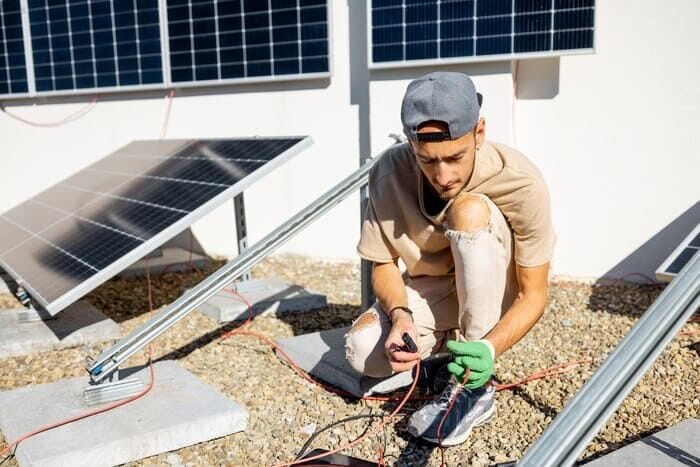
Instead of reactive cleaning, maintenance is planned based on performance data, environmental conditions, and system design. Service agreements often include defined performance benchmarks, periodic inspections, and response protocols for output deviations.
Professional teams use controlled cleaning methods such as deionized water systems, automated brushes, and robotic cleaning solutions depending on site conditions.
Partner selection directly impacts system reliability and long-term performance.
Key considerations include experience with large-scale installations, the ability to work with performance-linked service agreements, and access to monitoring and reporting tools that support energy tracking and ESG disclosures.
Solar is now part of core operational infrastructure. Maintenance is no longer a one-time activity. It is an ongoing process that directly impacts energy yield, cost efficiency, and reporting accuracy.
Businesses looking to streamline this process can use platforms like NatNavi Impact Hub to identify and connect with verified solar operations and maintenance providers aligned with sustainability and performance standards.
Performance Monitoring and Early Detection Systems for Commercial Solar Assets
In commercial solar installations, performance issues are rarely sudden. They develop gradually and are first visible through data.
Continuous monitoring systems track energy generation at the inverter and system level, allowing operations teams to identify deviations from expected output. A consistent drop in generation, not aligned with weather patterns or seasonal variation, is often the earliest indicator of issues such as soiling, partial shading, or equipment inefficiencies.
Instead of manual checks, most large-scale installations rely on centralized dashboards that provide real-time visibility into system performance. These platforms generate automated alerts for inverter faults, string-level underperformance, and abnormal output patterns, enabling faster response and reduced downtime.
Performance benchmarking is a key part of this process.
Energy output is regularly compared against historical data, irradiance levels, and expected generation models. Any deviation beyond defined thresholds triggers inspection or maintenance actions. This ensures that performance gaps are addressed before they scale into significant energy losses.
Periodic technical inspections remain essential, but they are structured and data-driven. These assessments typically cover inverter performance, electrical connections, mounting structures, and grounding systems, often aligned with warranty cycles and compliance requirements.
The objective is not routine checking, but maintaining continuous visibility into system performance.
Early detection reduces energy loss, improves operational efficiency, and ensures that solar systems consistently deliver expected output across their lifecycle.
Physical Risk Factors Affecting Solar Performance in Commercial Installations
In commercial solar systems, performance is not only influenced by cleaning and monitoring. Physical conditions across the installation site play a critical role in long-term efficiency.
Unplanned shading is one of the most common issues. Infrastructure additions such as HVAC units, antennas, or nearby construction can gradually introduce partial shading, reducing output at the string or system level. Vegetation growth around large facilities can also impact solar exposure over time if not managed within site planning.
Mechanical and structural integrity is another key factor.
Panel misalignment, mounting stress, loose cabling, and environmental wear can affect system performance and safety. These issues are typically identified during scheduled inspections rather than visual checks from ground level.
In large installations, wildlife interference is also considered at the design and maintenance stage. Instead of reactive fixes, preventive measures such as cable protection systems and controlled access zones are implemented to reduce long-term risk.
Facilities teams and O and M providers conduct periodic technical assessments aligned with operational schedules, ensuring that physical risks are identified early and addressed before they impact energy generation.
Maintaining system integrity at scale requires a proactive approach, where physical risk management is integrated into overall performance strategy.
Solar Performance as an Operational and ESG Strategy
Solar panel maintenance in commercial environments is not a routine activity. It is a long-term performance decision.
Across large installations, even small inefficiencies scale into measurable financial and operational impact. Systems that are actively managed deliver more consistent output and more predictable results.
For businesses, the value of solar lies not just in generation, but in how reliably that generation supports operational and sustainability objectives.
The organizations that extract the most value from solar are not the ones that install it once, but the ones that manage it continuously.
Solar performance, at scale, is a function of discipline, consistency, and system-level thinking.