

75F | IoT Building Automation & Energy Management
75F is a building automation technology company that designs, manufactures, and operates an Internet of Things (IoT) based Building Management…

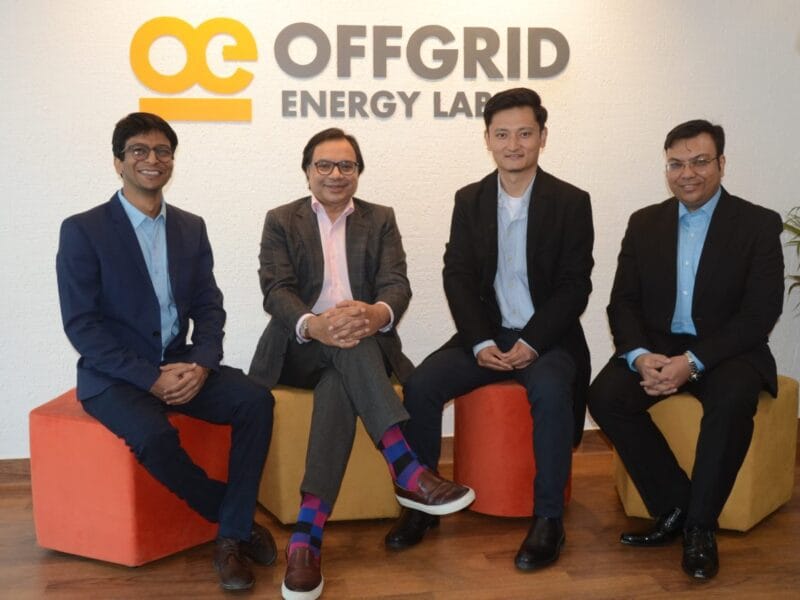
Offgrid Energy Labs is an Indian deep-tech energy storage company developing ZincGel, a proprietary zinc-bromide battery platform intended as an alternative to lithium-ion technology for stationary storage applications.
The company was incorporated in January 2018 and was incubated at the Startup Incubation and Innovation Centre (SIIC) of the Indian Institute of Technology, Kanpur. It was founded by four co-founders. Tejas Kusurkar and Brindan Tulachan lead research and product development, while Rishi K Srivastava and Ankur Agarwal lead business strategy, finance and partnerships.
Offgrid Energy Labs is headquartered in Gurugram, Haryana, India. In September 2025, the company raised 15 million US dollars in Series A funding led by Archean Chemical Industries Limited, with participation from existing investor Ankur Capital. The funding supported the company’s transition from laboratory-scale development to pilot manufacturing.
In 2026, Offgrid Energy Labs opened its first pilot manufacturing facility for ZincGel batteries in Hook, Hampshire, United Kingdom, featuring a 10 megawatt-hour production line. The company has also received support from India’s Department of Science and Technology, and counts Shell Ventures, Tata Power and TP Renewable Microgrid among its strategic investors and partners.
The company’s work is directed at the long-duration energy storage segment, supporting renewable energy integration, industrial power needs and data centre infrastructure, in the context of India’s broader transition toward non-fossil electricity generation.
SDG 7 (Affordable and Clean Energy) applies because ZincGel batteries are designed to store surplus renewable generation and dispatch it during peak demand, a function that directly supports wider adoption of solar and wind power.
SDG 9 (Industry, Innovation and Infrastructure) applies because the company is developing a patented battery chemistry from research stage through to pilot manufacturing infrastructure, representing new industrial capacity in an alternative storage technology.
SDG 13 (Climate Action) applies because long-duration storage of this kind is positioned to displace fossil-fuel-based backup power, such as diesel generation, in industrial and data centre settings, and to support grid decarbonization more broadly.
ZincGel is a zinc-bromide battery chemistry built around a proprietary, water-based electrolyte. Because the electrolyte is water-based rather than flammable, the system is designed to avoid the thermal-runaway failure mode associated with lithium-ion batteries.
The technology is engineered for a 6 to 16 hour discharge window, targeting the daily gap between renewable generation and peak power demand, with a stated design life of 20 years and full depth of discharge on a daily cycling basis. The chemistry relies on zinc and bromine rather than lithium, cobalt, nickel or rare earth elements, which the company states reduces reliance on geographically concentrated critical mineral supply chains.
Offgrid Energy Labs has built a patent portfolio covering its electrolyte formulation and electrode design, described in press coverage as comprising more than 25 intellectual property assets, and has stated that the platform uses simpler manufacturing processes than conventional lithium-ion production.
Offgrid Energy Labs operates in the long-duration energy storage (LDES) segment, an emerging category distinct from the short-duration storage market currently dominated by lithium-ion technology. Its primary customers are renewable energy developers, industrial facilities and data centre operators seeking multi-hour storage for grid balancing and backup power.
The company is backed by strategic investors spanning the chemicals, venture capital, energy and industrial sectors, including Archean Chemical Industries, Ankur Capital, Shell Ventures and Tata Power. Its stated differentiation from incumbent lithium-ion suppliers rests on its zinc-bromide chemistry, which targets lower material costs and reduced dependence on critical mineral imports.
Offgrid Energy Labs is developing an alternative to lithium-ion battery chemistry at a time when long-duration energy storage is becoming a stated priority for grid operators managing rising renewable capacity. Its zinc-bromide approach addresses a specific gap: storing power for the 6 to 16 hour window between generation and peak demand, using materials that are more geographically distributed than lithium, cobalt or nickel.
The company's founding team combines materials science, electrochemistry and financial and industry experience, and its transition from IIT Kanpur incubation to a UK pilot manufacturing line marks a step from laboratory research toward commercial production. Its investor base, spanning a chemicals manufacturer, a venture fund and established energy companies, suggests industry interest in its underlying technology.
As with most companies at pilot manufacturing stage, the central consideration for evaluators is execution risk in scaling from a 10 megawatt-hour pilot line to the gigafactory-scale production the company has stated it intends to build in India. The company's own disclosed figure, that ZincGel delivers 80 to 90 percent of lithium-ion's energy efficiency, is a useful benchmark for procurement teams weighing performance against the stated safety and supply chain advantages.
75F is a building automation technology company that designs, manufactures, and operates an Internet of Things (IoT) based Building Management…

Ace Green Recycling, Inc. is a battery recycling technology company that develops proprietary, hydrometallurgical processes to recover critical materials from…

AgBoost Tech Consultancy (ATC) is an India-based geospatial and artificial intelligence technology firm that builds decision-support systems for the agriculture,…