

A few years ago, sponsoring a tree-planting drive or running a community health camp was enough to call your business “responsible.” Investors, regulators, and even your own procurement partners now want something else: numbers.
That’s the real shift behind ESG. It isn’t a rebrand of CSR. It’s a different system altogether, one built to measure what CSR was only ever meant to express.
Table of Contents
Here’s where the two actually diverge, and why getting this distinction right matters more for your business than it used to.
CSR Has Heart, But Not Always a Scorecard
CSR is where most companies still start. It’s built around values, not metrics: sponsoring a local school, running a volunteer day, publishing a diversity statement.
That builds real trust with employees and communities. But it’s voluntary by design, and voluntary rarely comes with a shared measurement standard. Two companies can both claim strong CSR and be doing completely different things, which works fine for storytelling and not much else.
That’s the gap ESG was built to close.
What ESG Brings to Modern Sustainability Strategy
ESG takes the intention behind CSR and turns it into something measurable and comparable.
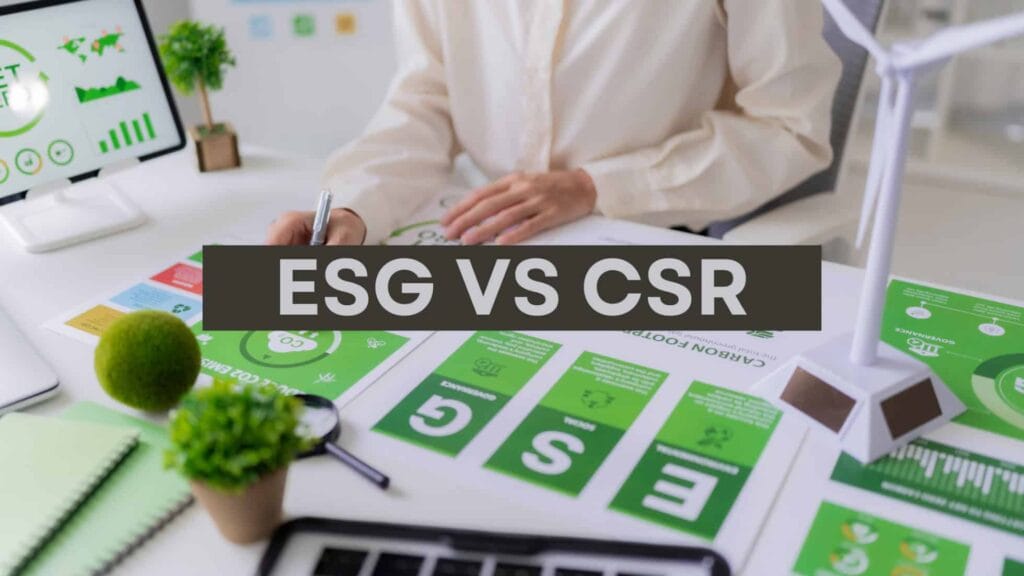
Environmental metrics track emissions, energy consumption, waste, water use, and climate risks. Social metrics look at workforce well-being, human rights, diversity, and product responsibility. Governance metrics focus on leadership oversight, ethical behaviour, transparency, and long-term risk management.
Companies use structured frameworks to guide this work. Many rely on the GRI Standards to build transparent sustainability disclosures. Investors and analysts often use metrics shaped by the Sustainability Accounting Standards Board to compare performance across industries. Businesses preparing for regulatory reporting look to the Corporate Sustainability Reporting Directive because it defines detailed requirements for companies operating in or linked to Europe.
This structure makes ESG part of business strategy, risk planning, and operational decision-making.
CSR and ESG in the Same Company
Take a mid-sized manufacturer. Under CSR, that company might plant trees every year near its facility and call it community impact. Good story, real goodwill.
Under ESG, the same company also tracks its Scope 1 emissions from the factory floor, discloses energy consumption per unit produced, screens its suppliers for labor practices, and reports governance details like board oversight of sustainability decisions using a recognised framework such as GRI.
Same company, same intent. One version is a story. The other is a dataset an investor or auditor can actually check.
CSR vs ESG, Side by Side
The two get confused because they both use the word “sustainability.” But one is built to inspire, and the other is built to be audited. Once you separate what each is actually optimizing for, the choice of which one leads your strategy gets a lot easier.
| CSR | ESG |
|---|---|
| Values-driven | Data-driven |
| Voluntary | Increasingly regulated |
| Community initiatives | Business-wide strategy |
| Storytelling | Measurable reporting |
| Reputation | Risk management |
The two aren’t competing. CSR still shapes culture. ESG is what proves the culture translates into performance a bank, investor, or regulator can verify.
Does Every Business Need ESG?
Large enterprises stopped debating this years ago. The real question sits with everyone else.
If you’re a startup, an SME, or a supplier to a bigger company, ESG probably touches you sooner than you’d expect:
- Startups raising capital increasingly get asked for basic environmental and governance data during due diligence, not just financial projections
- SMEs and manufacturers exporting to the EU or working with multinational buyers are being pulled into ESG reporting through their customers’ requirements, even without a direct regulatory mandate
- Exporters shipping into markets covered by the Corporate Sustainability Reporting Directive face indirect pressure through the supply chain, even if the directive doesn’t apply to them directly
- Suppliers to large enterprises are asked for ESG data as a condition of the contract, not as a nice-to-have
You don’t need a sustainability department to start. You need a handful of tracked metrics and a plan for what comes next.
Why ESG Should Be a Priority for Businesses Today
1. Regulation Is Moving Faster Than Most Businesses Expect
The Corporate Sustainability Reporting Directive is already live across the EU, and its scope widens with every reporting cycle. In the US, the SEC’s climate disclosure rules are pulling in more companies than most expect to be affected.
Waiting until a mandate applies to you directly is usually too late. By the time it does, you’re building reporting infrastructure under a deadline instead of on your own schedule.
Businesses that adapt early will be better positioned for compliance, transparency, and global competitiveness.
2. Investors rely on ESG data to assess long-term value
Capital doesn’t wait for a mandate either. Firms using frameworks like SASB now factor ESG performance into risk assessments before a term sheet is even discussed.
A company with two years of tracked environmental and governance data walks into that conversation differently than one explaining why it hasn’t started yet.
3. Procurement teams are already screening for it
Large buyers have quietly turned ESG into a purchasing filter. According to Aprovall, 92% of large buying organizations now require ESG data from their suppliers before doing business with them.
That changes what “competitive” means for a smaller supplier. Price and quality still matter, but they’re no longer the whole scorecard. Businesses with documented ESG practices are better positioned to qualify for procurement contracts, government tenders, and cross-border supply chains where the buyer’s own compliance depends on yours.
For a supplier still relying on CSR storytelling alone, that’s a gap worth closing before it shows up in a lost contract.
4. The Cost Savings Show Up Whether Anyone’s Watching or Not
Measuring energy use tends to surface waste nobody had flagged. Mapping a supply chain does the same, it exposes inefficiencies long before it satisfies a regulator.
Treat ESG only as a compliance exercise and you’ll miss this part. Treat it as an operational audit, and the savings show up in the P&L, not just the sustainability report.
5. Trust Is Shifting From Claims to Verifiable Data
Anyone can publish a sustainability page. Fewer companies back it with numbers a third party could actually check.
That gap is where ESG earns its keep. A verified emissions figure or a published governance policy carries more weight with a skeptical customer, or a candidate comparing offers, than another paragraph about caring for the planet.
CSR Isn’t Obsolete, It’s the Starting Point
CSR still earns its place, just not as the finish line.
It’s usually where sustainability starts inside a company, long before anyone’s tracking Scope 1 numbers. A recycling program, a volunteer day, a fair-wage policy: these build the internal culture and public goodwill that make the later ESG work land as authentic instead of defensive.
Skip this step and ESG risks looking like a compliance exercise bolted onto a company that never actually cared. Most credible ESG programs still have a CSR-shaped foundation underneath them.
Where CSR and ESG Actually Meet
The two work best as a sequence, not a switch. CSR builds the internal buy-in, leadership already cares about sustainability before ESG asks anyone to start measuring it.
Once that groundwork exists, ESG gives it a structure investors and regulators can actually verify. A company that jumps straight to ESG reporting without any CSR culture behind it often produces numbers nobody internally believes in. One that never moves past CSR produces goodwill nobody outside the company can verify.
The businesses that get this right treat CSR as the origin story and ESG as the audit trail.
Practical Steps for Businesses Beginning Their ESG Journey
Start with authentic CSR efforts that reflect your company’s personality. Build internal awareness and leadership support for sustainability. Begin capturing basic environmental and social data.
Choose a reporting structure such as the GRI Standards or the industry-specific metrics shaped by SASB. Identify what is truly material to your operations. Prepare for regulatory expectations early to avoid costly last-minute adjustments. Integrate sustainability goals into long-term planning so they become part of everyday decision-making.
If you start measuring now, you’re not just getting ahead of a filing deadline. You’re building the evidence base that regulators, investors, and procurement teams are already asking for.
ESG isn’t a reporting exercise bolted onto CSR. For a growing number of buyers and investors, it’s simply how they decide who they work with.