

Researchers and engineers have been exploring innovative methods to store and deliver thermal energy efficiently in the quest for sustainable energy solutions.
One such promising technology is the sand battery – a thermal energy storage system that utilises sand as a medium for storing heat.
Table of Contents
Let’s delve into the science behind sand batteries, elucidating their working principles, advantages, disadvantages, and potential applications in the renewable energy landscape.
What is a sand battery?
A sand battery is a thermal energy storage system that uses sand as the primary medium for holding heat.
Unlike chemical batteries, which store electricity directly, sand batteries convert surplus renewable energy into heat that can be released when needed.
The principle is simple but powerful. Excess electricity from solar or wind farms heats air through resistive elements, which is then circulated through a silo filled with sand.
The sand retains this heat at very high temperatures, sometimes exceeding 600°C, for months without significant losses.
How does a sand battery work?
The operation of a sand battery has two stages.
In the charging phase, renewable energy sources supply excess electricity to heat the sand.
In the discharging phase, the stored heat is transferred to water or air through a heat exchanger, supplying hot water, space heating, or even electricity generation in some cases. This makes sand batteries a reliable way to balance intermittent renewable sources and deliver energy on demand.
Finland’s First Commercial Sand Battery
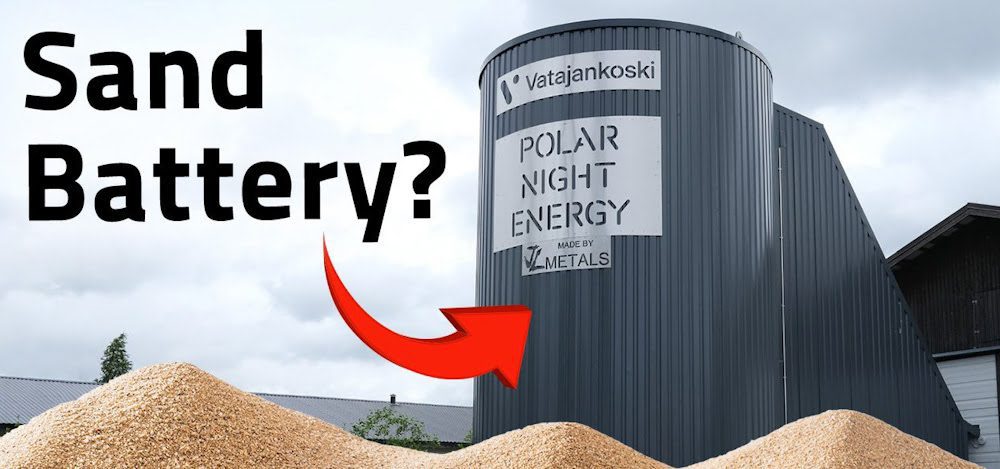
Polar Night Energy, a Finnish startup, built the world’s first operational sand battery in collaboration with the utility company Vatajankoski. Installed in Kankaanpää, this unit holds 100 tons of construction-grade sand inside a steel container.
It stores 8 megawatt-hours of energy and can discharge 200 kilowatts of heating power, enough to supply a community swimming pool and parts of the local district heating network serving 10,000 people.
The system uses surplus wind and solar power to charge the sand, ensuring that excess clean energy is not wasted. Local businesses benefit because they can access affordable district heating even during winter peaks, reducing reliance on fossil fuels.
Advantages of sand batteries
Sand batteries offer several advantages over conventional energy storage:
- Low cost: Sand is abundant, inexpensive, and requires no mining of rare minerals. This makes sand batteries far more affordable than lithium-ion storage.
- Scalability: Installations can be scaled from small community systems to large industrial plants capable of storing gigawatt-hours of energy.
- Longevity: Unlike chemical batteries that degrade with use, sand can retain its thermal storage properties for decades with minimal maintenance.
- Seasonal storage: The ability to hold heat for months gives sand batteries a unique advantage in colder climates where heating demand is high.
Limitations and Challenges
Despite their promise, sand batteries are not perfect. Their efficiency is lower compared to chemical batteries because converting heat back to electricity involves losses. Heat dissipation over time, although small, can reduce performance.
Current designs are better suited for heating rather than direct electricity generation, meaning sand batteries complement rather than replace other storage technologies.
Business and Sustainability Impact
For businesses, sand batteries present an opportunity to cut energy bills and emissions at the same time.
District heating operators can use them to stabilize prices during volatile energy markets. Industrial sectors that rely heavily on heat, such as food processing or chemical manufacturing, can store renewable energy as heat and reduce fossil fuel dependence.
From a sustainability perspective, sand batteries align with circular economy principles. They use low-grade sand rejected by the construction industry, turning waste material into a high-value energy storage medium.

If adopted globally, this approach could significantly reduce greenhouse gas emissions. According to the International Energy Agency, heating accounts for more than 50% of global energy consumption, so technologies like sand batteries could play a critical role in decarbonization, according to the IEA.
Applications Beyond Finland
The potential applications extend far beyond one Finnish town. Cities with district heating networks in Europe, Canada, and Asia could use sand batteries to reduce reliance on imported fossil fuels.
Remote industrial sites could install modular units to store renewable energy for off-grid operations. Future designs capable of storing 20 gigawatt-hours or more are being explored, which could supply hundreds of megawatts of continuous power.
Sand batteries are not a silver bullet, but they are one of the most promising thermal storage solutions developed so far. As renewable energy expands, technologies that can hold clean power for months rather than hours will be vital. With continued research to improve efficiency and integration with other systems, sand batteries could become a cornerstone of green energy infrastructure worldwide.