


Sustainable fashion has moved from a niche movement to a strategic priority for fashion brands, investors, and regulators. Growing consumer awareness, stricter environmental expectations, and increasing demand for supply chain transparency have encouraged many companies to adopt more responsible practices.
Despite this momentum, transforming the fashion industry remains far more complex than simply switching to sustainable materials or launching eco-friendly collections. Fashion supply chains span multiple countries, involve thousands of suppliers, and operate under constant pressure to reduce costs while responding quickly to changing consumer trends. These structural challenges often slow meaningful progress, even when businesses have genuine sustainability ambitions.
The biggest barriers to sustainable fashion are not isolated problems. Greenwashing, supply chain transparency, labour conditions, resource consumption, production costs, and regulatory gaps are closely connected. Addressing one challenge often requires improvements across several others.
Table of Contents
While these challenges affect different parts of the fashion industry, they are closely interconnected. One issue often reinforces another, creating a cycle that slows meaningful progress. Among these barriers, greenwashing has become one of the most visible because it undermines trust in genuine sustainability efforts.
Greenwashing
Greenwashing has become one of the biggest barriers to sustainable fashion because it undermines trust in genuine sustainability efforts. As more brands promote eco-friendly products, consumers, investors, and regulators increasingly expect those claims to be supported by clear evidence. When companies exaggerate or misrepresent their environmental performance, it becomes harder to distinguish businesses making meaningful improvements from those relying on marketing alone.
Greenwashing occurs when companies use vague sustainability messaging, misleading labels, or selective disclosures to appear more sustainable than they actually are. If you’re unfamiliar with how businesses use these tactics, our guide on greenwashing and false sustainability claims explains the most common practices and why they are becoming a growing business risk.
A global ESG risk report found a 12% decrease in companies linked to greenwashing risk in the year to June 2024, but a 30% increase in high‑severity greenwashing incidents, meaning fewer but more serious cases.
This shift suggests that while some businesses are becoming more cautious about making unsupported sustainability claims, regulators are paying closer attention to cases where misleading claims have the greatest impact. As sustainability becomes a competitive advantage, companies face increasing pressure to ensure that marketing claims are supported by verifiable data and transparent reporting.
Misleading Claims
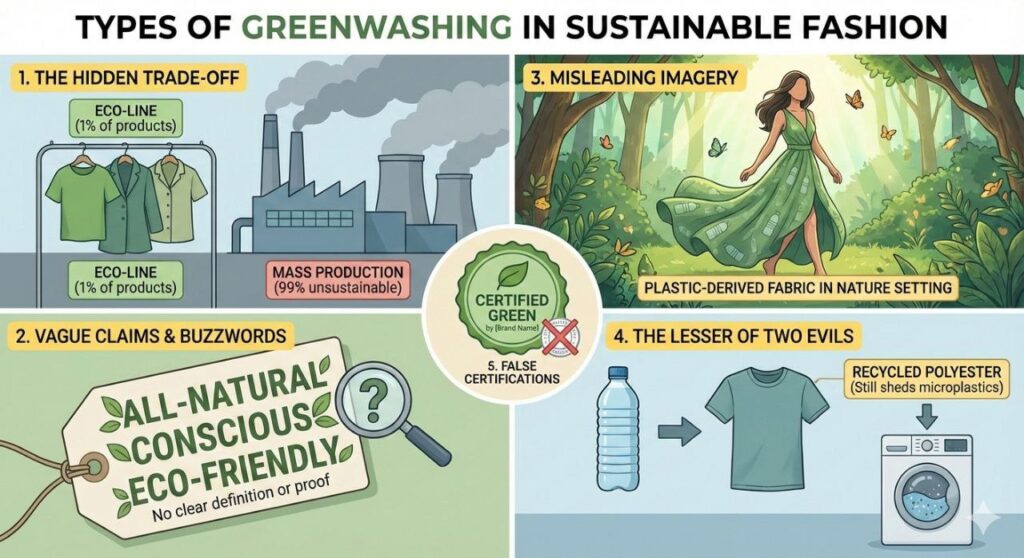
Brands use broad terms like “eco-friendly,” “all-natural,” or “sustainably made” without proof or clear definitions. These claims appear promising, but they often conceal the absence of genuine environmental benefits.
The International Consumer Protection Enforcement Network (ICPEN) runs a yearly check of websites to find misleading or unfair practices. This year, the UK’s CMA and the Netherlands’ ACM led the review, focusing on false environmental claims for the first time.
During the sweep, ICPEN members reviewed nearly 500 websites across sectors like fashion, cosmetics, and food to identify misleading “eco-friendly” claims.
Distracting With Minor Eco Claims
Some brands draw attention to small eco-friendly actions, like using recycled packaging or installing solar panels, while ignoring the much larger environmental harm caused by their main business activities, such as overproduction, pollution, or unsustainable materials.
This creates a false impression of responsibility without addressing the real issues.
“Green” Claims that Hide Harmful Practices
A product might be marketed as “green,” but the brand may still rely on harmful manufacturing processes, fossil fuels, water-intensive fabrics, or exploitative labour practices behind the scenes.
Visual Deception
Green-colored packaging, leaves, trees, and “earth” imagery are used to create the illusion of sustainability. These visuals can trick consumers into assuming environmental responsibility where it doesn’t exist.
Misleading labels
Brands may claim “plastic-free” for items that don’t normally contain plastic, or hide plastics in places consumers can’t see, like teabag linings or fabric microfibres. Certifications may also be invented or look official when they’re not.
Rebranding without action
Some companies simply change packaging, rename collections as “conscious,” “earth,” or “natural,” or create green-sounding sub-brands without making any actual improvement in production practices.
While misleading sustainability claims create a trust problem, the fashion industry’s environmental footprint presents an equally significant challenge. Among the most pressing environmental impacts is water pollution, which occurs throughout textile production and continues to affect ecosystems, freshwater resources, and communities around the world.
Water Pollution
Every garment carries a hidden water footprint. Cotton cultivation, fabric dyeing, washing, and finishing all depend on large volumes of freshwater, making water one of the fashion industry’s most heavily consumed natural resources. The challenge is not simply the amount of water used, but the way decades of manufacturing have been built around processes that prioritize speed, consistency, and cost over environmental performance.
Although cleaner technologies and water-efficient manufacturing methods already exist, widespread adoption remains uneven. Many suppliers operate on thin profit margins, making it difficult to invest in wastewater treatment systems, closed-loop water recycling, or cleaner dyeing technologies without stronger financial incentives or customer demand.
Textile Exchange’s 2023 Materials Market Report states that in the past 20 years, global fibre production has nearly doubled, from 58 million tonnes in 2000 to 116 million tonnes in 2022. If nothing changes, it could reach 147 million tonnes by 2030.
McKinsey’s analysis of fast fashion reports that between 2000 and 2014, the number of garments purchased per person increased by about 60%, while consumers kept clothing items for roughly half as long as they did 15 years earlier.
This rising demand strains global water supplies. The Ellen MacArthur Foundation estimates that textile production (including cotton farming) uses around 93 billion cubic meters of water every year, contributing heavily to water scarcity and pollution.
These figures highlight a broader industry challenge. As production volumes continue to grow, incremental efficiency improvements alone are unlikely to offset rising water demand. For many fashion businesses, reducing water consumption now requires redesigning products, improving supplier practices, investing in cleaner manufacturing technologies, and adopting circular business models rather than relying on isolated environmental initiatives.
As water scarcity becomes a growing business risk, brands can no longer treat water management as an issue confined to factories. Understanding where water is used, how wastewater is managed, and which suppliers present the highest risks is becoming an essential part of building resilient and future-ready supply chains.
Exploitative Labour Practices
Behind every finished garment is a network of workers responsible for spinning fibres, weaving fabrics, dyeing materials, and assembling clothing. While this global workforce has enabled fashion to become faster and more affordable, it has also created persistent challenges around wages, worker safety, and human rights.
As brands compete on price and speed, manufacturing is often outsourced across multiple countries, making it difficult to maintain consistent labour standards throughout the production process. Although many companies have introduced supplier codes of conduct and ethical sourcing policies, monitoring working conditions across complex supplier networks remains a significant challenge.
Production contracts are often awarded to suppliers that can deliver quickly and at the lowest possible cost. Under these commercial pressures, investments in worker safety, training, or fair wages are frequently treated as expenses rather than competitive advantages.
Subcontracting adds another layer of complexity. Suppliers facing tight production deadlines or cost pressures may outsource work to smaller factories without the brand’s knowledge or approval. These facilities often receive less oversight, increasing the risk of unsafe working conditions, excessive overtime, child labour, or below-living wages. As a result, even brands with responsible sourcing policies can struggle to identify and address labour issues throughout their supply chains.
Improving labour standards ultimately depends less on publishing policies and more on building stronger supplier relationships, improving visibility beyond first-tier manufacturers, and rewarding responsible production instead of simply rewarding the lowest cost.
Chemical Use
Few consumers think about chemistry when buying a shirt, yet chemicals influence almost every stage of textile manufacturing. They create vibrant colours, improve fabric performance, prevent wrinkles, and increase durability. The problem is that many conventional chemical processes were developed long before sustainability became a priority.
Although safer alternatives and certified chemical management systems are becoming more widely available, transitioning away from hazardous substances requires investment, supplier training, upgraded manufacturing facilities, and stronger oversight throughout the supply chain.
Many conventional textile dyes, finishing agents, and treatment chemicals were originally developed because they deliver reliable results at a relatively low cost. Without effective wastewater treatment and chemical management, however, substances such as azo dyes, formaldehyde, and heavy metals can contaminate rivers, damage ecosystems, and create long-term health risks for factory workers and nearby communities.
Managing chemicals effectively is becoming part of long-term business resilience. Companies that strengthen chemical oversight today are likely to face fewer regulatory challenges, improve buyer confidence, and reduce operational risks as global product safety standards continue to tighten.
Lack of Transparency
Most fashion brands know where their finished products are assembled, but far fewer have complete visibility into every stage of their supply chain. Raw materials may pass through multiple countries, processors, and subcontractors before becoming a finished garment, making transparency one of the industry’s most difficult operational challenges.
Limited visibility makes it difficult to verify environmental performance, labour standards, material sourcing, and sustainability claims. When businesses cannot accurately trace how products are made, they also struggle to identify risks, measure improvements, and demonstrate credible sustainability performance.
Transparency is not simply about sharing information. It is the foundation for improving nearly every sustainability challenge discussed in this article. Without reliable supply chain data, businesses cannot effectively verify environmental claims, monitor labour conditions, measure water consumption, manage hazardous chemicals, or demonstrate compliance with emerging sustainability regulations.
Improving transparency requires more than publishing supplier lists. Businesses increasingly need digital traceability systems, supplier collaboration, third-party verification, and consistent sustainability reporting to build confidence across their value chains.
Greater transparency is gradually becoming a competitive advantage rather than simply a reporting exercise. Businesses that understand their supply chains in detail are generally better equipped to respond to new regulations, manage risks, and build lasting credibility with customers and investors.
High Cost of Sustainable Production
One of the biggest misconceptions about sustainable fashion is that higher prices are simply the result of expensive materials. In reality, the cost difference reflects a much broader challenge. Sustainable production often requires cleaner technologies, stronger labour standards, certified materials, and investments that conventional manufacturing has largely avoided.
While sustainable alternatives continue to improve, they often operate within supply chains that have not yet achieved the same level of efficiency as conventional production.
Sustainable materials such as organic cotton, recycled fibres, and innovative bio-based textiles typically cost more because they are produced at smaller volumes, require additional certification, and involve more rigorous environmental and social standards. Similarly, responsible manufacturing practices, including wastewater treatment, cleaner energy, fair wages, and safer working conditions, increase production costs that are rarely reflected in conventional fashion pricing.
The higher cost reflects the way today’s fashion market works. Brands compete aggressively on price, while consumers have become accustomed to inexpensive clothing. Passing higher production costs on to customers is therefore much more difficult than simply improving manufacturing practices.
This pricing pressure creates a difficult business decision. Companies may genuinely want to improve sustainability performance but often struggle to justify investments when competitors continue to offer lower-priced products produced under less demanding environmental and labour standards.
Reducing these costs will require more than technological innovation. Greater consumer demand, larger production volumes, supportive government policies, improved recycling infrastructure, and stronger collaboration across the value chain will all be necessary to make sustainable production economically competitive.
Looking only at today’s production costs tells an incomplete story. As regulations tighten, resource prices fluctuate, and consumer expectations continue to evolve, investments that appear expensive today may become an important source of long-term competitiveness.
Fast Fashion Culture
The environmental challenges facing the fashion industry cannot be understood without looking at the business model that shaped them. Fast fashion transformed clothing into a product that is cheaper, produced faster, and replaced more frequently than at any other point in history. While this approach made fashion more accessible, it also intensified many of the sustainability challenges facing the industry today.
To maintain low prices and short production cycles, brands often depend on inexpensive raw materials, high-volume manufacturing, and suppliers operating under significant time and cost constraints. These pressures can make it more difficult to invest in cleaner production technologies, improve labour conditions, strengthen supply chain transparency, or adopt more sustainable materials without increasing product prices.
Consumer behaviour also plays an important role. Over the past two decades, clothing has become significantly more affordable, while new collections are introduced more frequently than ever before. This has encouraged shorter product lifecycles, higher purchasing rates, and growing volumes of textile waste as garments are discarded long before the end of their usable life.
The environmental impact extends far beyond waste. Continuous production increases demand for water, energy, chemicals, and raw materials while generating higher greenhouse gas emissions throughout the value chain. As production volumes rise, even meaningful sustainability improvements at individual factories can struggle to offset the industry’s overall environmental footprint.
Shifting away from this model does not necessarily mean producing fewer garments. It means creating greater value from every product through durability, repair, resale, rental, recycling, and more efficient resource use. Brands that embrace these approaches are likely to be better prepared for the next phase of the industry’s evolution.
Lack of Government Support
The fashion industry operates across borders, but sustainability regulations rarely do. A single garment may involve suppliers in multiple countries, each with different environmental laws, labour standards, and reporting requirements. This fragmented regulatory landscape makes consistent sustainability performance far more difficult than it appears.
This fragmented regulatory landscape creates uncertainty for fashion businesses operating across global supply chains. A company may face strict sustainability requirements in one market while sourcing products from countries where environmental protections, labour regulations, or chemical controls are significantly weaker. As a result, maintaining consistent sustainability standards throughout the value chain becomes increasingly complex.
The challenge extends beyond regulation alone. Many businesses, particularly small and medium-sized enterprises, face limited access to financial incentives, recycling infrastructure, technical guidance, and funding needed to invest in cleaner manufacturing technologies or circular business models. Without stronger public support, the cost of sustainability often falls primarily on individual businesses.
At the same time, regulatory expectations continue to evolve. Governments are placing greater emphasis on climate disclosures, product traceability, responsible sourcing, and environmental accountability. Businesses that delay preparing for these changes may face increasing compliance costs and competitive disadvantages as new policies are introduced.
Rather than waiting for regulations to become more consistent, many leading companies are already aligning their operations with higher sustainability standards. Preparing early not only reduces future compliance challenges but also creates greater flexibility as expectations continue to evolve across global markets.
How Sustainable Fashion Can Move Forward
There is no single solution to sustainable fashion because no single issue is holding the industry back. The challenges discussed throughout this article, including greenwashing, water pollution, labour practices, chemical management, supply chain transparency, production costs, fast fashion, and evolving regulations, are deeply interconnected. Addressing one barrier often requires progress across several others.
Meaningful change begins with greater transparency. Businesses need better visibility into their supply chains to verify sustainability claims, monitor environmental performance, improve labour standards, and manage risks more effectively. Reliable data, third-party verification, and collaboration across suppliers create the foundation for informed decision-making rather than relying on marketing claims alone.
At the same time, businesses need to rethink how value is created. Investing in cleaner manufacturing, circular business models, responsible sourcing, product durability, and resource efficiency should not be viewed simply as environmental initiatives. These investments help build more resilient operations, strengthen customer trust, improve regulatory readiness, and reduce long-term business risks.
Governments, industry organizations, technology providers, investors, and consumers also play an important role in accelerating this transition. Stronger regulations, financial incentives, innovation, and changing consumer expectations can help create the market conditions needed for sustainable business models to compete more effectively with conventional fashion.
The future of sustainable fashion will not be determined by one breakthrough material or a single environmental initiative. It will depend on how successfully the entire value chain works together to balance commercial success with environmental responsibility and social accountability.