

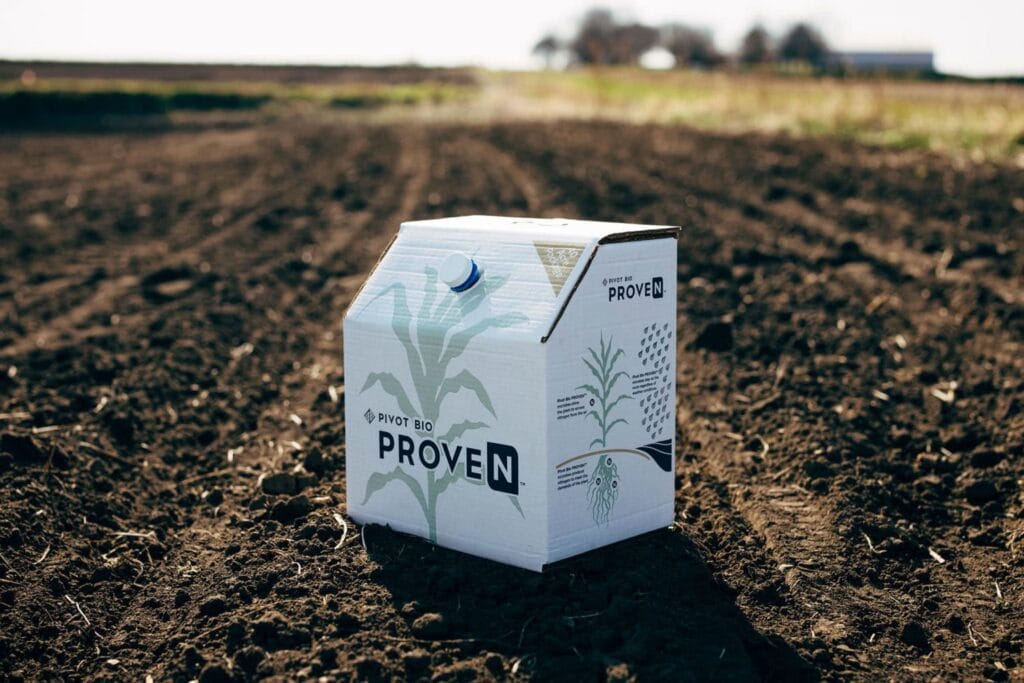
Pivot Bio is a useful test of whether a sustainable product can win on cost. It’s not a “buy green” proposition. It says its microbes can replace part of the expensive input (nitrogen fertiliser) and do it at a lower cost than the fertiliser would.
Table of Contents
The company passed $100 million in revenue in 2023, with its products on more than 5 million acres of US corn. Since then, Pivot Bio has cut prices by 30% for 2026, laid off staff and consolidated its research in St. Louis. Independent university trials have also questioned how much yield benefit the products deliver. For agribusiness professionals making procurement or investment decisions, independent, peer-reviewed trials are particularly important because they offer a clearer, unbiased picture of performance and support due diligence. Third-party data helps build trust in new agricultural technology and strengthens the business case for adoption.
Here’s how Pivot Bio looks from a buyer’s or investor’s seat. What is it actually selling, and does the evidence support it?
What Pivot Bio replaces, and what it doesn’t
Nitrogen is one of the grower’s most expensive inputs and globally only about 46% of the nitrogen applied to cropland ends up in the crop (xin Zhang, University of Maryland). Pivot Bio’s gene-edited microbes are applied to the seed or in the furrow and produce nitrogen from the air at the root zone. The end result is that the grower can use less synthetic fertiliser.

Its original PROVEN 40 product replaced about 20% of a grower’s synthetic nitrogen. Early sales pitches talked about 40 pounds per acre. The company now says the right number depends on soil, tillage, and how much nitrogen is applied and when, so it asks growers to work out a field-by-field figure with one of its 30-plus agronomists.
For the buyer or investor that’s effectively saying any headline saving figure is an average across a very wide range of outcomes.
The current corn product (PROVEN G3) replaced 34 lbs of Nitrogen per acre in the trials the company was still finishing up when it launched and also yielded 0.9 bushels per acre more than the untreated plots. That’s a modest yield increase and not really the point. Pivot Bio’s agronomy director positions the product as a lower-cost alternative to part of a grower’s nitrogen program. The commercial case is all about cost.
Where the evidence holds up and where it gets contested
What university trials found
In 2023 a committee of researchers from Midwestern agricultural experiment stations looked at 61 nitrogen rate trials of biological N-fixing products. 59 of those trials showed no significant yield advantage over nitrogen alone (DTN report). The products came from several companies, including Pivot Bio.
One researcher quoted in the coverage offered practical advice for growers: run replicated strip trials on your own farm before making any commitment. With yield monitors and GPS, that’s very straightforward to do.
What Pivot Bio says in response
Pivot Bio told DTN that their microbial nitrogen is a reliable replacement for synthetic fertiliser and that no nitrogen product on yield alone. They also cite their own trial programs with universities (Purdue and the University of Georgia amongst them) where yield was maintained with reduced levels of synthetic nitrogen.
Worth pointing out: the company state that those trials are designed with their agronomists. That doesn’t make them wrong, it just means they’re not the same as a study that’s been run completely at arm’s length.
How to read the environmental claims
Nitrogen that the crop doesn’t take up can turn into nitrous oxide (a greenhouse gas which is some 300 times more potent than CO2). That’s why replacing synthetic nitrogen with nitrogen made at the root is important for emissions and water quality. Pivot Bio points to research which shows nitrate leaching decreasing by an average of about 10kg of nitrogen per hectare (roughly 9lbs per acre).
Those numbers are from the company itself. So are their aggregate totals for emissions avoided and fertiliser displaced. If you’re going to be reusing them in a sustainability report then you need to ask for the methodology and the date range. For ESG reporting and in any external communication it’s always preferable to have an independent third party or peer reviewed data where possible. Having verified numbers at your disposal will go a long way to enabling the sustainability officer to be credible and to meet the increasing levels of disclosure that are now expected.
For any team looking to bolster their ESG reporting, the key steps are: to get third party verification or certification of the emissions and fertiliser savings, to reference published and peer reviewed trial results where possible and to document the methodology and source of any claim. It’s worth working with the growers to track the actual input reductions on the fields and asking your suppliers to provide the supporting documentation or verification from a recognised sustainability framework. That sort of thing goes a long way to underpinning your reporting.
What it costs in 2026, and why the discount keeps moving
Pivot Bio cut prices by 30% for 2026 compared with the previous two seasons. They say the cost per pound of nitrogen replaced will be at least 25% lower than what farmers currently pay for synthetic nitrogen.
Then fertiliser markets tightened. In March 2026, Pivot Bio said synthetic prices were rising, and conventional supply was constrained. It said it would raise US production and keep its lower prices. By April, CEO Chris Abbott told St. Louis Magazine the product was about 65% cheaper than synthetic fertiliser, up from 20% to 25% before the spike.
Look at what moved. Pivot Bio’s price stayed flat. The benchmark it’s against moved, so the gap could close again if synthetic nitrogen prices come down.
The company have also launched a multi-year price and supply assurance programme which allows growers to lock in their nitrogen prices for 2026 and beyond. If you’re looking at budgeting your inputs over a number of seasons then you’ll need to read the terms very carefully.
Is it actually cheaper? On Pivot Bio’s numbers it is, but only for the nitrogen it replaces. That varies by field so you’ll need to look at the product cost per acre against the pounds of nitrogen it replaces on your own field. The headline discount is far less important than that field level figure.
Why the 45Z tax credit gives ethanol producers a reason to care
In September 2026, Treasury and the IRS issued guidance under the 45Z clean fuel production credit. According to Pivot Bio’s announcement, the notice formally recognises on-farm practices, including the use of its nitrogen, in carbon intensity scoring for renewable fuels.
The company says the guidance covers fuel produced in 2025 and 2026, and that G3 lowers a corn grower’s score in the approved calculator because it replaces synthetic nitrogen. A final 45Z rule is still expected later this year.
Here’s why that matters beyond the farm. Nitrogen ceases to be just an input decision and becomes a line in an ethanol plant’s tax credit calculation. The ethanol producer buys the corn, so they now have a reason to ask how it was grown. The amount of value that creates will be dependent on the final rule and the producer’s overall score. And as the source is Pivot Bio’s own release, you should read the IRS notice before you go and build a business case on it.
Food and beverage companies with agricultural supply chain targets are faced with the same question. Fertiliser is a major source of farm level emissions and buyers are increasingly demanding field level data rather than product level claims. A microbial product is one of the tools available. Application timing, placement and rate are other levers. For supply chain managers looking to drive improvement the practical steps would be to ask their suppliers for field verified data on their fertiliser use and emissions reductions, to push for pilot work or strip trials with a microbial product and to work with growers to improve the data collection across their sourcing regions.
A national snack food company worked with corn growers in Iowa to run strip trials comparing standard fertiliser practice to Pivot Bio and tracking input reductions and yields with field level data. They used the results in their ESG reporting and to guide future procurement. That kind of real world example is useful for supply chain folks to help them see what a practical application of field verified data might look like in their own sourcing.
A venture-backed company still settling into its shape.
Pivot Bio is a private company so its numbers are company reported. Their last major raise was a $430m Series D in 2021 (co-led by DCVC and Temasek) which CNBC reported at a valuation of circa $2bn. In 2023, under new CEO Chris Abbott, revenue crossed the $100m mark (up over 60%). We haven’t been able to find a more recent revenue figure from the company.
The last 18 months have been anything but smooth. Fertiliser Daily reported in June 2025 that Pivot Bio had laid off 62 people and had moved its research out of Berkeley to St Louis. In April 2026 Abbott announced further consolidation in the St Louis area with a further $7m commitment on top of the $22m that had been committed three years previously to the Hazelwood manufacturing site in St Louis (St Louis Magazine).
Lower prices, R&D and manufacturing all in one place. That’s the unit economics we’re looking at. That’s our take on it, not something Pivot Bio has said.
The range is expanding. Beyond corn, they have a cotton product, a grain sorghum product which is currently approved and they’ve also increased their production of their winter wheat product in September 2026. Europe is next on the list. They joined EuropaBio in April 2026, though of course any launch in Europe would require European regulatory approval.
What to watch before the 2027 season
- PROVEN G3+ (planned for 2027) across seed, liquid in-furrow and dry application per Pivot Bio’s September 2026 announcement.
- The final 45Z rule (expected later this year).
- Independent data on G3. They’d obviously not finished their own trial data at launch.
- Synthetic nitrogen prices. Pivot Bio itself was forecasting in March 2026 that the fertiliser disruption would persist well into 2027 so the price gap could well remain wide for the foreseeable future. That’s their forecast, not a fait accompli.
Judge it as a nitrogen cost lever first.
Pivot Bio’s own agronomists are positioning the product as a way of replacing some of your nitrogen at a lower cost. The emissions and water quality benefits are a consequence of that if the replacement works in your fields.
If you’re farming, get a field specific replacement rate and run a strip trial before you commit. If you’re buying corn or ethanol, get the suppliers to provide you with measured farm level data. If you’re investing, look at the unit economics much more closely than the revenue headlines.
Pivot Bio is one of many companies working on nitrogen, soil and agricultural emissions. NatNavi Company Intelligence organises sustainability companies by what they do, the problems they address, and the industries they serve, so you can see what each one does and whether it fits your needs.